
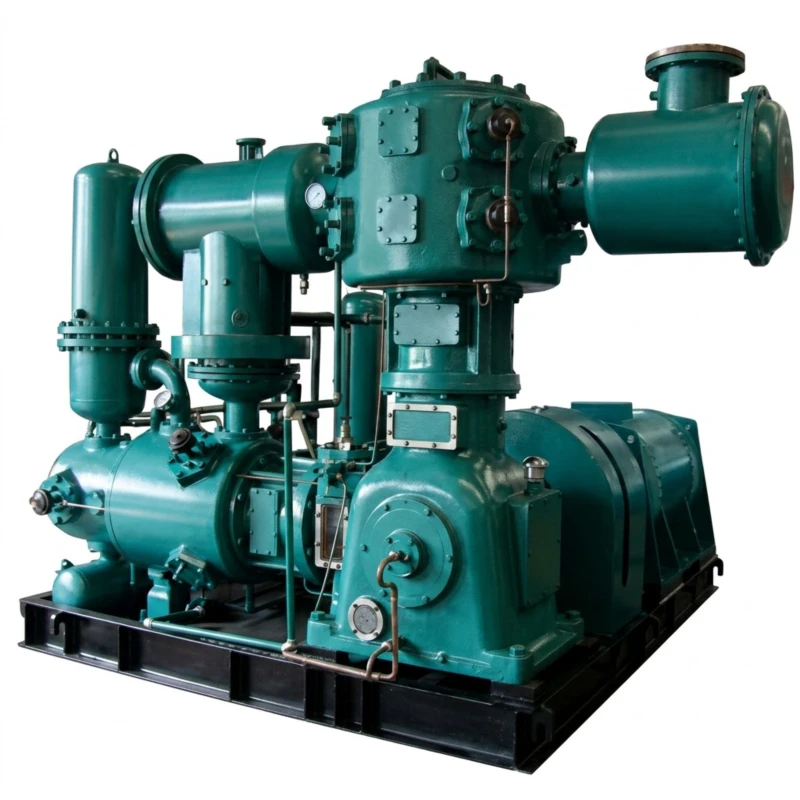
Oil-Free Air Compressor for PET Bottle Blowing — Two-Series Reciprocating System
Dedicated Oil-Free Compressed Air for Plastic Blow Moulding Lines · Blowing Air 4.0 MPa, 2.7–150 m³/min · Mould Control Air 0.60–1.20 MPa, 3–130 m³/min · 37–2000 kW
The oil-free air compressor for PET bottle blowing is a purpose-built two-series compressed air system engineered for the specific high-pressure and purity requirements of PET stretch-blow moulding machines, PP blow moulding lines, and plastic container forming equipment. The system covers two independent compressed air demands on every blow moulding production floor: a high-pressure oil-free blowing air supply at 4.0 MPa (40 bar) for stretching and blowing PET preforms into finished bottle shapes; and a separate medium-pressure oil-free control air supply at 0.60 to 1.20 MPa for mould clamping mechanisms, preform heating controls, and machine instrument air.
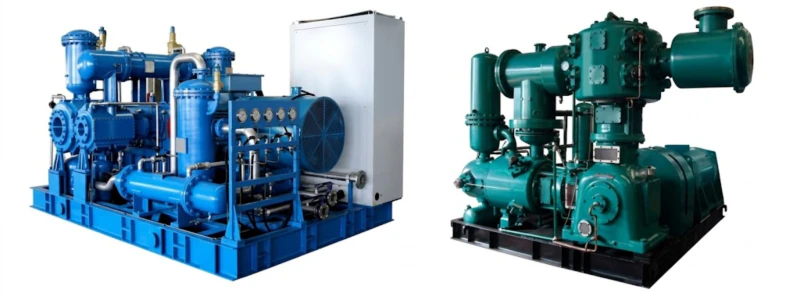
Series A — Plastic Blow Moulding Air Compressor: 43 standard models covering 2.7 m³/min to 150 m³/min at discharge pressure of 4.0 MPa (3.0 MPa optional), in three mechanical configurations: twin-column three-stage reciprocating (ZW, LW, DW, MW series); four-column four-stage reciprocating (4MW, MW four-column series); and twin-screw plus single-stage piston combination (LG.ZW integrated series). Drive power ranges from 37 kW to 1,700 kW with voltage options of 380 V, 6 kV, and 10 kV. Custom single-unit capacity up to 2,000 kW available on request.
Series B — Oil-Free Air Compressor for Mould and Instrument Air: 15 standard models covering 3 m³/min to 130 m³/min at discharge pressures of 0.60 to 1.20 MPa, using twin-column single-stage and two-stage configurations with PTFE piston rings and distance piece isolation for guaranteed zero oil carry-over. Drive power from 22 kW to 800 kW. Custom capacity up to 2,000 kW on request.
Blowing Air: 4.0 MPa
2.7–150 m³/min
Control Air: 0.60–1.20 MPa
58 Standard Models
37–2000 kW
380 V / 6 kV / 10 kV
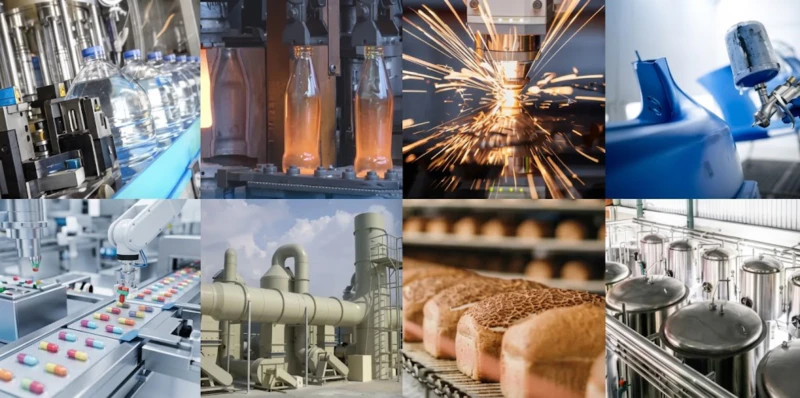
Typical applications: PET stretch-blow moulding lines for water, beverage, juice, and edible oil bottles · PP and HDPE extrusion blow moulding for food containers · Linear and rotary PET blow moulding machines · Cosmetic and personal care bottle production · Pharmaceutical PET and PP container lines · Large-format PET bottle blowing for 5-gallon water jugs · Hot-fill PET bottle production
Series A — Oil-Free Air Compressor for Plastic Blow Moulding
High-Pressure Blowing Air · Discharge Pressure 4.0 MPa (3.0 MPa Optional) · Flow 2.7–150 m³/min
Series A models supply the high-pressure blowing air demand of PET stretch-blow moulding and plastic bottle production lines. Three mechanical configurations are available: twin-column three-stage (ZW, LW, DW, MW series — compact modular configuration for single-machine and small-line installations); four-column four-stage (4MW, MW four-column series — balanced high-flow configuration for large multi-machine blow moulding plants); and LG.ZW integrated series (twin-screw compressor for low-pressure first-stage plus single-stage piston for high-pressure second-stage — compact combined unit for medium-flow installations). Custom single-unit capacity up to 2,000 kW available on request.
| No. | Model | Pattern | Flow (m³/min) | Pressure (MPa) | Dimensions L×W×H (mm) | Weight (t) | Power (kW) | Voltage (V) |
|---|---|---|---|---|---|---|---|---|
| 1 | ZW-2.7/40(30) Modular | Twin-col. 3-stage | 2.7 | 4.0 (3.0) | 1530×1680×1375 | 2.80 | 37 | 380 |
| 2 | ZW-4/40(30) Modular | Twin-col. 3-stage | 4 | 4.0 (3.0) | 1920×1900×2580 | 4.50 | 45 | 380 |
| 3 | LW-4/40(30) Modular | Twin-col. 3-stage | 4 | 4.0 (3.0) | 3435×950×2006 | 2.70 | 45 | 380 |
| 4 | LW-6/40(30) Modular | Twin-col. 3-stage | 6 | 4.0 (3.0) | 3435×950×2006 | 2.70 | 65 | 380 |
| 5 | LW-8/40(30) Modular | Twin-col. 3-stage | 8 | 4.0 (3.0) | 3400×1550×2350 | 3.50 | 90 | 380 |
| 6 | LW-10/40(30) Modular | Twin-col. 3-stage | 10 | 4.0 (3.0) | 3400×1550×2350 | 3.50 | 110 | 380 |
| 7 | LW-12/40(30) Modular | Twin-col. 3-stage | 12 | 4.0 (3.0) | 3932×1695×2720 | 5.20 | 132 | 380 |
| 8 | LW-16/40(30) Modular | Twin-col. 3-stage | 16 | 4.0 (3.0) | Belt: 3932×1695×2720 / Coupling: 2800×3600×2450 | 5.50 | 185 | 380 |
| 9 | LW-18/40(30) Modular | Twin-col. 3-stage | 18 | 4.0 (3.0) | Belt: 3500×2600×1850 / Coupling: 2800×3600×2450 | 6.00 | 200 | 380/6K/10K |
| 10 | LW-20/40(30) Modular | Twin-col. 3-stage | 20 | 4.0 (3.0) | Belt: 4545×1700×2450 / Coupling: 2800×3600×2450 | 8.00 | 220 | 380/6K/10K |
| 11 | LW-22/40(30) Modular | Twin-col. 3-stage | 22 | 4.0 (3.0) | Belt: 4545×1700×2450 / Coupling: 3850×3100×2800 | 8.00 | 250 | 380/6K/10K |
| 12 | LW-23.5/40(30) Modular | Twin-col. 3-stage | 23.5 | 4.0 (3.0) | Belt: 4545×1700×2450 / Coupling: 3850×3100×2800 | 8.00 | 250 | 380/6K/10K |
| 13 | LW-24/40(30) Modular | Twin-col. 3-stage | 24 | 4.0 (3.0) | Belt: 4850×2250×2800 / Coupling: 3850×3100×2800 | 9.50 | 280 | 380/6K/10K |
| 14 | LW-25/40(30) Modular | Twin-col. 3-stage | 25 | 4.0 (3.0) | Belt: 4850×2250×2800 / Coupling: 3850×3100×2800 | 9.50 | 280 | 380/6K/10K |
| 15 | LW-28/40(30) | Twin-col. 3-stage | 28 | 4.0 (3.0) | 2960×1685×2335 | 6.50 | 315 | 380/6K/10K |
| 16 | DW-30/40(30) | Twin-col. 4-stage | 30 | 4.0 (3.0) | 6145×3225×2335 | 11.00 | 355 | 6K/10K |
| 17 | DW-35/40(30) | Twin-col. 4-stage | 35 | 4.0 (3.0) | 6585×3590×2095 | 13.00 | 400 | 6K/10K |
| 18 | DW-40/40(30) | Twin-col. 4-stage | 40 | 4.0 (3.0) | 6585×3600×2100 | 13.00 | 450 | 6K/10K |
| 19 | DW-50/40(30) | Twin-col. 4-stage | 50 | 4.0 (3.0) | 6585×3600×2100 | 13.00 | 550 | 6K/10K |
| 20 | DW-60/40(30) | Twin-col. 4-stage | 60 | 4.0 (3.0) | 8500×4400×3020 | 17.00 | 650 | 6K/10K |
| 21 | DW-70/40(30) | Twin-col. 4-stage | 70 | 4.0 (3.0) | 8500×2440×3020 | 18.00 | 750 | 6K/10K |
| 22 | MW-20/40(30) Modular | Four-col. 4-stage | 20 | 4.0 (3.0) | 5000×3100×2600 | 16.50 | 200 | 380 |
| 23 | MW-22/40(30) Modular | Four-col. 4-stage | 22 | 4.0 (3.0) | 5000×3100×2600 | 17.00 | 220 | 380 |
| 24 | MW-25/40(30) Modular | Four-col. 4-stage | 25 | 4.0 (3.0) | 5000×3100×2600 | 17.50 | 250 | 380/6K/10K |
| 25 | MW-28/40(30) Modular | Four-col. 4-stage | 28 | 4.0 (3.0) | 5000×3100×2600 | 18.00 | 280 | 380/6K/10K |
| 26 | MW-30/40(30) Modular | Four-col. 4-stage | 30 | 4.0 (3.0) | 6000×3200×2600 | 21.00 | 315 | 380/6K/10K |
| 27 | MW-35/40(30) Modular | Four-col. 4-stage | 35 | 4.0 (3.0) | 6000×3200×2600 | 25.00 | 355 | 380/6K/10K |
| 28 | MW-40/40(30) Modular | Four-col. 4-stage | 40 | 4.0 (3.0) | 6500×3200×2600 | 26.00 | 400 | 6K/10K |
| 29 | MW-45/40(30) Modular | Four-col. 4-stage | 45 | 4.0 (3.0) | 7000×3200×2600 | 28.00 | 450 | 6K/10K |
| 30 | MW-50/40(30) Modular | Four-col. 4-stage | 50 | 4.0 (3.0) | 7500×3200×2600 | 30.00 | 500 | 6K/10K |
| 31 | 4MW-90/40(30) | Four-col. 4-stage | 90 | 4.0 (3.0) | 6800×3900×3200 | 26.00 | 1000 | 6K/10K |
| 32 | MW-100/40(30) | Four-col. 4-stage | 100 | 4.0 (3.0) | 6800×3900×3200 | 26.00 | 1100 | 6K/10K |
| 33 | MW-120/40(30) | Four-col. 4-stage | 120 | 4.0 (3.0) | 6800×3900×3200 | 26.00 | 1200 | 6K/10K |
| 34 | MW-150/40(30) | Four-col. 4-stage | 150 | 4.0 (3.0) | 8500×3900×3200 | 27.00 | 1700 | 6K/10K |
| 35 | LG.ZW-6/40(30) | Screw+piston combo | 6 | 4.0 (3.0) | 4000×2400×1850 | 4.20 | 72 | 380 |
| 36 | LG.ZW-8/40(30) | Screw+piston combo | 8 | 4.0 (3.0) | 4000×2400×1850 | 4.50 | 96 | 380 |
| 37 | LG.ZW-10/40(30) | Screw+piston combo | 10 | 4.0 (3.0) | 4000×2400×1850 | 6.50 | 132 | 380 |
| 38 | LG.ZW-15/40(30) | Screw+piston combo | 15 | 4.0 (3.0) | 4500×2400×1850 | 8.00 | 200 | 380 |
| 39 | LG.ZW-20/40(30) | Screw+piston combo | 20 | 4.0 (3.0) | 4500×2400×1850 | 10.00 | 280 | 380 |
| 40 | LG.ZW-25/40(30) | Screw+piston combo | 25 | 4.0 (3.0) | 4500×2400×1850 | 10.00 | 315 | 380 |
| 41 | LG.ZW-30/40(30) | Screw+piston combo | 30 | 4.0 (3.0) | 5500×2400×1850 | 12.00 | 370 | 380 |
| 42 | LG.ZW-40/40(30) | Screw+piston combo | 40 | 4.0 (3.0) | 6200×2400×1850 | 16.00 | 450 | 380 |
| 43 | LG.ZW-50/40(30) | Screw+piston combo | 50 | 4.0 (3.0) | 6200×2400×1850 | 17.00 | 565 | 380 |
Note: “(30)” in the model name indicates 3.0 MPa optional pressure rating available on the same frame. “Modular” designation indicates skid-mounted modular configuration for compact installation. LG.ZW series uses twin-screw low-pressure stage plus single-stage piston high-pressure stage in one integrated unit. Custom single-unit capacity within 11 kW to 2,000 kW available on request.
Series B — Oil-Free Air Compressor for Mould Clamping and Instrument Air
For Mould Mechanism Control and Instrument Air · Discharge Pressure 0.60–1.20 MPa · Flow 3–130 m³/min
Series B models supply the medium-pressure oil-free air for blow moulding machine clamping cylinders, preform oven control valves, conveyor positioning systems, and general plant instrument air. All 15 models use PTFE piston rings and distance piece isolation for guaranteed zero oil contamination. Custom capacity up to 2,000 kW on request.
| No. | Model | Pattern | Flow (m³/min) | Pressure (MPa) | Dimensions L×W×H (mm) | Weight (t) | Power (kW) | Voltage (V) |
|---|---|---|---|---|---|---|---|---|
| 1 | ZW-3/8 | Twin-col. single-stage | 3 | 0.80 | 763×720×1274 | 0.58 | 22 | 380 |
| 2 | ZW-6/10 | Twin-col. two-stage | 6 | 1.00 | 2340×910×2070 | 1.80 | 55 | 380 |
| 3 | LW-10/10 | Twin-col. two-stage | 10 | 1.00 | 2340×910×2070 | 1.80 | 75 | 380 |
| 4 | LW-15/10 | Twin-col. two-stage | 15 | 1.00 | 2630×1550×2332 | 3.00 | 132 | 380 |
| 5 | LW-20/10 | Twin-col. two-stage | 20 | 1.00 | 2632×1550×2332 | 3.00 | 132 | 380 |
| 6 | LW-25/12 | Twin-col. two-stage | 25 | 1.20 | 2760×1600×2190 | 3.70 | 190 | 380 |
| 7 | LW-35/12 | Twin-col. two-stage | 35 | 1.20 | 3015×1655×2245 | 6.50 | 250 | 10K |
| 8 | LW-40/10 | Twin-col. two-stage | 40 | 1.00 | 2890×1600×2173 | 4.12 | 260 | 380 |
| 9 | LW-50/8 | Twin-col. two-stage | 50 | 0.80 | 2630×16525×2235 | 6.50 | 315 | 380 |
| 10 | LW-60/8 | Twin-col. two-stage | 60 | 0.80 | 2380×1500×2560 | 6.00 | 350 | 10K |
| 11 | DW-60/8 | Twin-col. two-stage | 60 | 0.80 | 5000×1800×1450 | 6.00 | 350 | 10K |
| 12 | DW-85/8 | Twin-col. two-stage | 85 | 0.80 | 5456×3518×2535 | 13.00 | 500 | 6K/10K |
| 13 | DW-100/8 | Twin-col. two-stage | 100 | 0.80 | 5456×3518×2535 | 13.00 | 600 | 6K/10K |
| 14 | DW-110/8 | Twin-col. two-stage | 110 | 0.80 | 5500×3518×2535 | 13.00 | 630 | 6K/10K |
| 15 | DW-130/8 | Twin-col. two-stage | 130 | 0.80 | 6000×3640×3000 | 18.00 | 800 | 6K/10K |
Note: Custom single-unit capacity within 11 kW to 2,000 kW available on request for Series B. Both oil-free (PTFE piston rings) and standard lubricated configurations are available on Series B frames for non-oil-sensitive applications.
Why PET Bottle Blowing Demands High-Pressure Oil-Free Air
The PET Stretch-Blow Moulding Process
PET bottle production by stretch-blow moulding compresses a reheated PET preform between two stages: low-pressure pre-blowing at 0.6 to 1.0 MPa to initiate the bubble, then high-pressure final blowing at 3.0 to 4.0 MPa (30 to 40 bar) to stretch the softened preform radially and axially against the cold mould cavity walls, forming the precise bottle shape. The final blowing stage requires substantial air volume delivered at very high pressure in a short cycle time — typically 0.3 to 0.8 seconds per blow cycle. At a production rate of 20,000 to 80,000 bottles per hour on a modern high-speed rotary blow moulding machine, the total compressed air demand at 4.0 MPa is significant, easily reaching 20 to 60 m³/min of free air delivery for a fully loaded production line.
Oil contamination of the high-pressure blowing air is unacceptable in food, beverage, and pharmaceutical PET packaging applications. Oil mist carried into the bottle interior during blowing cannot be removed by subsequent rinsing — it becomes trapped in the finished container and contaminates the product filled into it. Regulatory food contact material standards and beverage industry codes of practice prohibit oil-contaminated blowing air, making oil-free compressed air the mandatory specification for all food and beverage PET bottle production.
Three Mechanical Configurations in Series A
At 4.0 MPa, reaching the required pressure ratio from atmospheric requires multiple compression stages. The twin-column three-stage configuration (ZW, LW series) uses three progressively smaller cylinders in series — LP, intermediate-pressure, and HP — with inter-stage cooling between each stage, achieving 4.0 MPa in a relatively compact twin-column frame suited to single-machine or small multi-machine installations. The four-column four-stage configuration (MW, DW, 4MW series) adds a fourth compression stage, which improves thermodynamic efficiency at very high pressure ratios and provides better inter-stage temperature management for large-flow applications requiring sustained high-output at 4.0 MPa. The LG.ZW combined series uses a twin-screw compressor as the low-pressure first stage (atmospheric to approximately 0.7 MPa) feeding a single-stage reciprocating piston as the high-pressure second stage (0.7 to 4.0 MPa) — this combination delivers better part-load efficiency than a pure reciprocating design because the screw stage can be VFD-controlled for variable-speed operation, while the piston stage handles the high-pressure duty efficiently.
5 Core Advantages of This PET Bottle Blowing Compressor System
Intrinsically Oil-Free at 4.0 MPa
PTFE composite piston rings in all compression stages eliminate oil from the entire 4.0 MPa blowing air circuit. Unlike oil-injected high-pressure compressors that rely on multi-stage coalescing filters to achieve oil-free status, these oil-free reciprocating units contain no oil in the compression space at any stage — the blowing air delivered to the bottle mould cavity is free of hydrocarbons by design, providing the highest achievable food safety guarantee for PET beverage packaging.
Three Mechanical Configurations — One Series
The three Series A configurations — twin-column three-stage, four-column four-stage, and LG.ZW combined screw-plus-piston — cover the full spectrum from small single-machine installations (ZW-2.7 at 37 kW) through large multi-line beverage plant stations (MW-150 at 1,700 kW). Choosing the right configuration for each scale of production avoids over-engineering a small line with heavy industrial machinery or under-powering a high-output beverage plant with undersized equipment.
LG.ZW Combined Unit — Compact and Efficient
The LG.ZW series integrates a twin-screw low-pressure stage with a reciprocating high-pressure stage on a single skid, reducing installation footprint by approximately 30% compared with separate LP screw plus HP piston compressor combinations. The screw stage handles the bulk of the compression work efficiently at low-to-medium pressure ratios, while the piston stage handles the demanding final high-pressure compression to 4.0 MPa — combining the efficiency advantages of each technology for the pressure range where each performs best.
Field-Maintainable in Production Environment
PTFE piston rings, valve plates, and inter-stage gaskets are all field-replaceable items that can be changed by plant maintenance staff during planned production stoppages. On a beverage bottling line where compressor downtime means lost production at thousands of bottles per hour, the ability to perform maintenance within a plant maintenance team without specialist contractors significantly reduces the risk of extended production loss from compressor-related stoppages.
Medium-Voltage Options for Large Beverage Plants
Large PET beverage plants with multiple filling and blowing lines operating simultaneously require substantial electrical power. Models from 200 kW upward are available with 6 kV and 10 kV motor options for direct connection to medium-voltage plant substations, eliminating the need for low-voltage step-down transformer capacity for the compressor room and reducing total installed electrical cost for large-scale operations.
Typical Application Scenarios
Water and Beverage PET Bottle Production
Mineral water, purified water, carbonated beverages, juice, tea, and energy drinks represent the largest single application for PET bottle blowing compressed air. A typical 24,000 bottles-per-hour rotary blow moulding machine for 0.5-litre PET water bottles consumes approximately 8 to 12 m³/min of blowing air at 4.0 MPa. A large beverage plant running four blowing machines simultaneously would require Series A station capacity of 30 to 50 m³/min. The LW and DW modular series in the 10 to 50 m³/min range serve the majority of beverage PET bottle blowing requirements.
Series A: LW-10 to DW-50 | Series B: LW-10/10 to LW-20/10
Pharmaceutical and Healthcare PET Packaging
Pharmaceutical oral solid dose bottles, syrup bottles, IV solution containers, and medical diagnostic reagent bottles all require PET or PP blow moulding with certified oil-free blowing air as a GMP (Good Manufacturing Practice) requirement. The oil-free blowing air standard in pharmaceutical packaging is typically more stringent than beverage applications, requiring formal air quality testing and documentation as part of the facility qualification process. The smaller ZW and LW series models (2.7 to 15 m³/min) at 380 V serve pharmaceutical packaging lines where batch sizes and machine speeds are lower than high-volume beverage production.
Series A: ZW-2.7 to LW-12 | Series B: ZW-3/8 to LW-10/10
Edible Oil and Condiment PET Bottles
Edible oil, soy sauce, vinegar, cooking wine, and other food condiment PET containers are typically larger-format bottles (1 to 5 litres) with thick walls that require slightly higher blowing air volume per bottle than thin-wall water bottles. The 3.0 MPa optional pressure variant available on most Series A models is often sufficient for thick-wall cooking oil bottles where the lower blowing pressure is adequate to fully expand the heavy-wall PET preform, reducing energy consumption versus full 4.0 MPa operation. The LW-18 to LW-28 range suits medium-scale edible oil packaging lines.
Series A: LW-18 to DW-40 | Series B: LW-15/10 to LW-25/12
Large-Scale Beverage Plant Multi-Line Stations
Large-scale beverage manufacturing facilities running 8 to 20 PET blow moulding machines simultaneously require centralized high-pressure compressor stations with total capacity of 80 to 200 m³/min at 4.0 MPa. The four-column four-stage MW series (MW-20 to MW-150) and the heavy-duty 4MW-90 model are designed for these large centralized station applications. Multiple units operate in parallel with lead-lag control to match station output to actual machine demand as lines start, stop, and change over between bottle formats. The 6 kV and 10 kV motor options on large MW models are essential for direct medium-voltage connection in large beverage plant electrical systems.
Series A: MW-50 to MW-150, 4MW-90 | Series B: DW-85/8 to DW-130/8
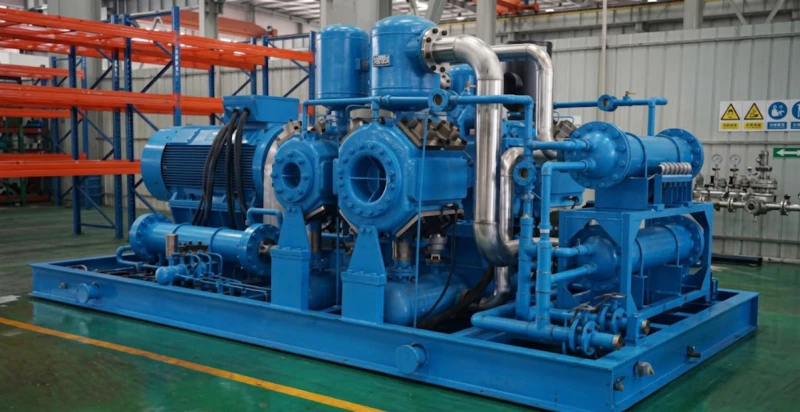
Installed at Customer Sites
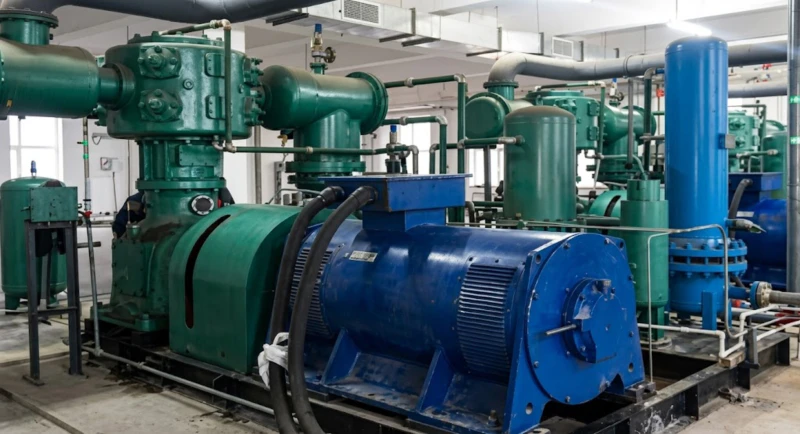
The oil-free high-pressure reciprocating compressor series has been installed in PET bottle blowing air stations across beverage bottling plants, food packaging facilities, and pharmaceutical packaging lines. The following images show representative customer site installations and maintenance operations.
How to Size a PET Bottle Blowing Compressed Air Station
Determine Blowing Pressure Requirement
PET bottle blowing pressure varies by preform wall thickness, bottle format, and machine type. Standard CSD (carbonated soft drink) and water bottles require 3.5 to 4.0 MPa. Large-format thick-wall bottles and handles may be satisfied at 3.0 MPa. The blow moulding machine manufacturer specifies the required blowing air pressure at the machine manifold; add 0.2 to 0.3 MPa for distribution and filter pressure reduction to arrive at the compressor discharge pressure. Most installations standardize on 4.0 MPa to cover all bottle formats on the same station.
Calculate Total Blowing Air Demand
Sum the free air delivery (FAD) requirement of each blow moulding machine on the line. The machine manufacturer provides FAD consumption at 4.0 MPa in m³/min or m³/h in their technical specification. For machines not yet specified, a rule of thumb is approximately 0.4 to 0.7 m³ of FAD per 1,000 bottles for standard 0.5-litre PET water bottles — adjust proportionally for larger bottle volumes. Add a 20% margin for peak demand, blowback, and future capacity growth.
Choose Series A Configuration
For total station FAD below 30 m³/min, LW three-stage modular units are the most compact and cost-effective option. For 30 to 70 m³/min, DW four-stage or MW four-column models provide better efficiency at sustained high output. For 70 to 150 m³/min, MW and 4MW four-column models are the primary choice. For medium-flow installations where installation footprint is constrained, the LG.ZW combined series (6 to 50 m³/min) offers the most compact solution while maintaining competitive energy efficiency through VFD-capable screw low-pressure staging.
Plan Air Treatment and Redundancy
Downstream of the high-pressure compressor, install: an after-cooler to reduce discharge air temperature to within 10 deg C of ambient; a high-pressure moisture separator and automatic drain to remove condensate; a high-pressure coalescing filter rated at 0.01 micron and oil content below 0.01 mg/m³ as a final verification stage; and a high-pressure air receiver of at least 5 to 8 times the compressor FAD in litres to buffer demand peaks. Plan for N plus 1 redundancy — at least one standby unit — because blowing air failure stops all blow moulding machines immediately, with significant production loss per hour of downtime.
Frequently Asked Questions — Oil-Free Air Compressor for PET Bottle Blowing
Ready to Specify an Oil-Free Blowing Air System for Your PET Bottle Line?
Our engineering team provides free blowing air station sizing for PET and plastic blow moulding projects — including total FAD calculation, blowback recovery allowance, configuration recommendation (three-stage, four-stage, or LG.ZW combined), air treatment specification, and electrical starting data. Factory-direct pricing, global export, and full project documentation.