
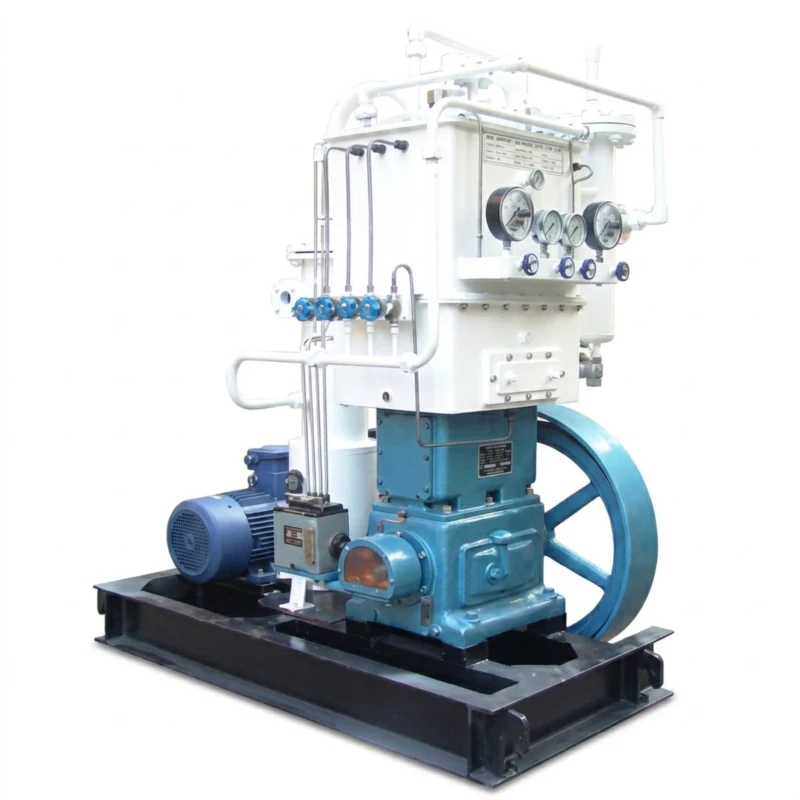
Acetylene Compressor — High-Pressure and Medium/Low-Pressure Two-Series
Reciprocating Piston Compressor for Dissolved Acetylene and Industrial C₂H₂ Processing · High-Pressure 2.00–3.0 MPa, 20–600 m³/h · Medium/Low-Pressure 0.10–1.0 MPa, 20–4000 m³/h · 3–400 kW
The acetylene compressor is a purpose-designed reciprocating piston compression system built specifically for the explosive, flammable, and chemically reactive nature of acetylene gas (C₂H₂). Acetylene decomposes violently above 1.5 bar partial pressure in pure form, and its compression requires explosion-proof motor configurations, oil-free PTFE or water-lubricated cylinder designs, copper-free or copper-limited wetted metal alloys, strict temperature limits at each compression stage, and gas-tight sealing with leakage collection systems that eliminate any ignition risk. Standard air or gas compressors cannot be safely used for acetylene compression under any circumstances.
This two-series range covers the complete spectrum of industrial acetylene compression needs. Series A — High-Pressure Acetylene Compressor covers 29 standard models with flow from 20 m³/h to 600 m³/h at discharge pressure of 2.00 to 3.0 MPa, supplying the filling pressure for dissolved acetylene cylinders and high-pressure acetylene manifolds. All Series A models use twin-column three-stage reciprocating configuration with explosion-proof YB-series motors, variable-frequency drive options, and inlet micro-positive pressure design to prevent air ingress. Series B — Medium/Low-Pressure Acetylene Compressor covers 25 standard models with flow from 20 m³/h to 4,000 m³/h at discharge pressures of 0.10 to 1.0 MPa, covering the chemical industry mid-process compression and transfer requirements for acetylene in PVC synthesis, vinyl acetate production, and other acetylene-chemistry processes. Drive power ranges from 3 kW to 400 kW. Custom single-unit capacity within 11 kW to 400 kW available on request across both series.
All models incorporate explosion-proof electrical components (YB160L to YB355L motor series), oil-free water-lubricated or PTFE ring cylinder configurations to prevent hydrocarbon ignition sources, stainless steel or copper-free alloy valve and seal materials, and micro-positive-pressure inlet design to ensure the gas path remains under slight positive pressure at all times, preventing air from entering and forming a flammable mixture with acetylene in the compression cylinder or distribution pipework.
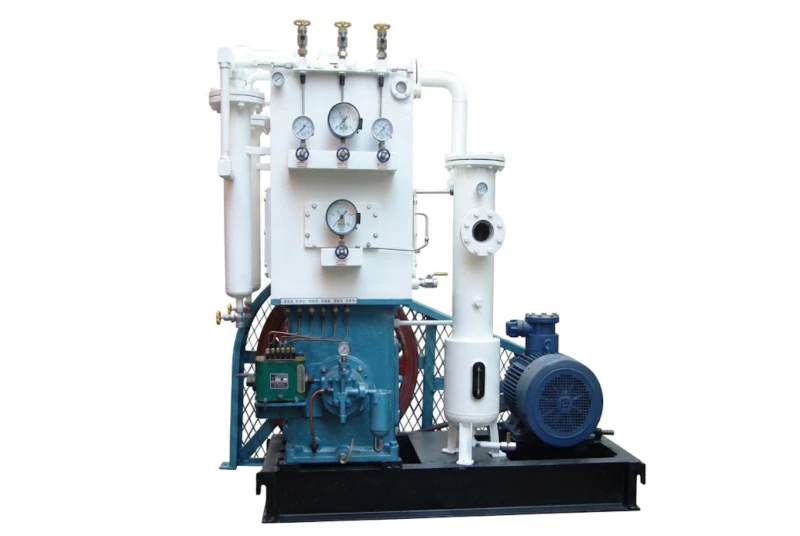
High-P: 2.00–3.0 MPa
Med/Low-P: 0.10–1.0 MPa
20–4000 m³/h
54 Standard Models
3–400 kW
Explosion-Proof YB Motors
VFD Variable-Speed Options
Micro-Positive Inlet Pressure
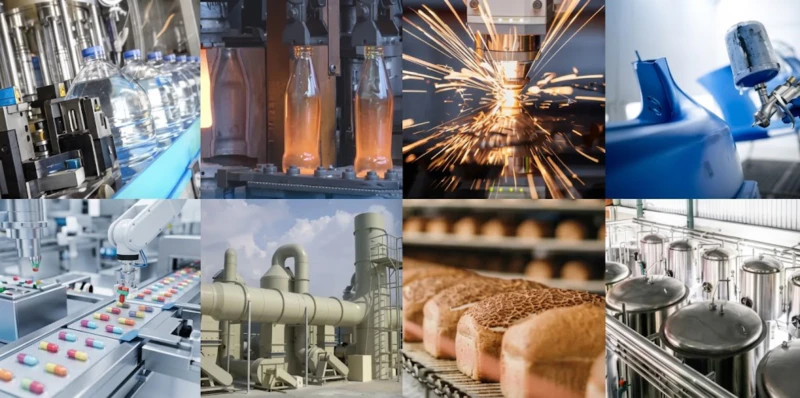
Typical applications: Dissolved acetylene cylinder filling stations · Acetylene gas plant high-pressure compression · PVC (polyvinyl chloride) synthesis via acetylene-HCl process · Vinyl acetate monomer (VAM) production · Acetaldehyde synthesis · Calcium carbide-based acetylene chemical chain · Acetylene gas pipeline distribution · Metal cutting and welding gas supply stations · Acetic acid and acetic anhydride production · Acetylene black production
Series A — High-Pressure Acetylene Compressor
For Dissolved Acetylene Cylinder Filling and High-Pressure Manifold Supply · Discharge Pressure 2.50 MPa · Flow 20–600 m³/h
All 29 Series A models use twin-column three-stage reciprocating configuration with micro-positive-pressure inlet design . Flow is stated in m³/h of acetylene gas at inlet conditions. Models with variable-frequency (VFD) notation include an integrated VFD for output matching to generator capacity at dissolved acetylene plants. Motor designations use the YB explosion-proof series (YB160L through YB315S). All 380 V supply. Custom single-unit capacity within 11 kW to 400 kW available on request.
| No. | Model | Pattern | Flow (m³/h) | Pressure (MPa) | Dimensions L×W×H (mm) | Weight (t) | Motor | Power (kW) |
|---|---|---|---|---|---|---|---|---|
| 1 | 2Z-0.34/25 Modular | Twin-col. 3-stage | 20 | 2.50 | 1865×900×2000 | 1.80 | YB160L-6 | 5.5 |
| 2 | 2Z-0.67/25 Modular | Twin-col. 3-stage | 40 | 2.50 | 1865×900×2000 | 1.80 | YB160L-6 | 7.5 |
| 3 | 2Z-0.8/25 Modular | Twin-col. 3-stage | 50 | 2.50 | 1865×900×2000 | 1.80 | YB160L-6 | 11 |
| 4 | 2Z-0.8/25E VFD Modular | Twin-col. 3-stage | 25~50 | 2.50 | 1865×900×2000 | 1.80 | YB160L-6 | 11 |
| 5 | 2Z-1/25 | Twin-col. 3-stage | 60 | 2.50 | 2035×1240×2234 | 2.60 | YB200L-8 | 15 |
| 6 | 2Z-1/25E VFD | Twin-col. 3-stage | 30~60 | 2.50 | 2035×1240×2234 | 2.60 | YB225S-8 | 15 |
| 7 | 2Z-1.34/25 | Twin-col. 3-stage | 80 | 2.50 | 2035×1240×2234 | 2.60 | YB225M-8 | 18.5 |
| 8 | 2Z-1.34/25E VFD | Twin-col. 3-stage | 40~80 | 2.50 | 2035×1240×2234 | 2.60 | YB225M-8 | 18.5 |
| 9 | 2Z-1.5/25 | Twin-col. 3-stage | 90 | 2.50 | 2035×1240×2234 | 2.60 | YB225S-8 | 18.5 |
| 10 | 2Z-1.5/25E VFD | Twin-col. 3-stage | 45~90 | 2.50 | 2035×1240×2230 | 2.60 | YB225M-8 | 22 |
| 11 | 2Z-1.67/25 | Twin-col. 3-stage | 100 | 2.50 | 2035×1240×2230 | 2.60 | YB225M-8 | 22 |
| 12 | 2Z-1.67/25E VFD | Twin-col. 3-stage | 50~100 | 2.50 | 2035×1240×2230 | 2.60 | YB225M-8 | 22 |
| 13 | 2Z-1.82/25 | Twin-col. 3-stage | 110 | 2.50 | 2035×1240×2230 | 2.60 | YB225M-8 | 22 |
| 14 | 2Z-1.82/25E VFD | Twin-col. 3-stage | 55~110 | 2.50 | 2035×1240×2230 | 2.60 | YB225M-8 | 22 |
| 15 | 2Z-2/25 | Twin-col. 3-stage | 120 | 2.50 | 2035×1240×2230 | 2.60 | YB225M-8 | 30 |
| 16 | 2Z-2/25E VFD | Twin-col. 3-stage | 60~120 | 2.50 | 2035×1240×2230 | 2.60 | YB225M-8 | 30 |
| 17 | 3Z-2.34/25 | Twin-col. 3-stage | 140 | 2.50 | 1840×1660×2400 | 4.20 | YB250M-8 | 30 |
| 18 | 3Z-2.34/25E VFD | Twin-col. 3-stage | 70~140 | 2.50 | 1840×1660×2400 | 4.20 | YB280M-8 | 30 |
| 19 | 3Z-2.67/25 | Twin-col. 3-stage | 160 | 2.50 | 1840×1660×2400 | 4.20 | YB280M-8 | 37 |
| 20 | 3Z-2.67/25E VFD | Twin-col. 3-stage | 80~160 | 2.50 | 1840×1660×2400 | 4.20 | YB280M-8 | 37 |
| 21 | 3Z-3/25 | Twin-col. 3-stage | 180 | 2.50 | 1840×1660×2400 | 4.20 | YB280M-8 | 37 |
| 22 | 3Z-3/25E VFD | Twin-col. 3-stage | 90~180 | 2.50 | 1840×1660×2400 | 4.20 | YB280M-8 | 45 |
| 23 | 3Z-3.34/25 | Twin-col. 3-stage | 200 | 2.50 | 1840×1660×2400 | 4.30 | YB280M-8 | 45 |
| 24 | 3Z-3.34/25E VFD | Twin-col. 3-stage | 100~200 | 2.50 | 1840×1660×2400 | 4.30 | YB315S-8 | 55 |
| 25 | 3Z-4.17/25 | Twin-col. 3-stage | 250 | 2.50 | 1840×1660×2400 | 4.50 | YB315S-8 | 55 |
| 26 | 3Z-4.17/25E VFD | Twin-col. 3-stage | 125~250 | 2.50 | 1840×1660×2400 | 4.50 | YB315S-8 | 55 |
| 27 | 3Z-4.5/25 | Twin-col. 3-stage | 270 | 2.50 | 1840×1660×2400 | 4.50 | YB315S-8 | 55 |
| 28 | 3Z-4.5/25E VFD | Twin-col. 3-stage | 135~270 | 2.50 | 1840×1660×2400 | 4.50 | YB315S-8 | 65 |
| 29 | 3Z-5/25E VFD | Twin-col. 3-stage | 150~300 | 2.50 | 1840×1660×2400 | 4.80 | YB355S-8 | 75 |
Note: All Series A models operate at 380 V. “VFD” (variable-frequency drive) models provide stepless output adjustment from approximately 50% to 100% of rated flow, enabling matching of compressor output to acetylene generator capacity. Flow values in m³/h at inlet conditions. All models use YB explosion-proof motor series. Custom single-unit capacity within 11 kW to 400 kW available on request.
Series B — Medium/Low-Pressure Acetylene Compressor
For Chemical Industry Mid-Process Acetylene Compression · Discharge Pressure 0.10–1.0 MPa · Flow 20–4000 m³/h
Series B covers 25 standard models for chemical-industry acetylene process compression — PVC synthesis, vinyl acetate production, acetaldehyde synthesis, and acetylene pipeline distribution. All models use twin-column two-stage or single-stage configuration with micro-positive-pressure inlet design. The low-pressure range (0.60/0.80 MPa) covers the majority of acetylene chemical process applications; the large DW-13/16.5 model handles high-flow low-pressure transfer at 1.65 MPa for industrial gas distribution. All 380 V except DW-13/16.5 which uses YB400-18. Custom capacity within 11 kW to 400 kW available.
| No. | Model | Pattern | Flow (m³/h) | Pressure (MPa) | Dimensions L×W×H (mm) | Weight (t) | Motor | Power (kW) |
|---|---|---|---|---|---|---|---|---|
| 1 | 2Z-0.34/8(6) | Twin-col. two-stage | 20 | 0.80 (0.60) | 1865×900×2000 | 1.65 | YB160L-6 | 3 |
| 2 | 2Z-0.67/8(6) | Twin-col. two-stage | 40 | 0.80 (0.60) | 1865×900×2000 | 1.65 | YB160L-6 | 5.5 |
| 3 | 2Z-0.8/8(6) | Twin-col. two-stage | 50 | 0.80 (0.60) | 1865×900×2000 | 1.65 | YB160L-6 | 7.5 |
| 4 | 2Z-1/8(6) | Twin-col. two-stage | 60 | 0.80 (0.60) | 2035×1240×2234 | 2.40 | YB160L-6 | 7.5 |
| 5 | 2Z-1.34/8(6) | Twin-col. two-stage | 80 | 0.80 (0.60) | 2035×1240×2234 | 2.40 | YB160L-6 | 11 |
| 6 | 2Z-1.5/8(6) | Twin-col. two-stage | 90 | 0.80 (0.60) | 2035×1240×2234 | 2.40 | YB200L-8 | 13 |
| 7 | 2Z-1.67/8(6) | Twin-col. two-stage | 100 | 0.80 (0.60) | 2035×1240×2234 | 2.40 | YB200L-8 | 15 |
| 8 | 2Z-1.82/8(6) | Twin-col. two-stage | 110 | 0.80 (0.60) | 2035×1240×2234 | 2.60 | YB200L-8 | 15 |
| 9 | 2Z-2/8(6) | Twin-col. two-stage | 120 | 0.80 (0.60) | 2035×1240×2230 | 2.60 | YB225M-8 | 18 |
| 10 | 2Z-2.16/8(6) | Twin-col. two-stage | 130 | 0.80 (0.60) | 1840×1660×2400 | 3.80 | YB225M-8 | 22 |
| 11 | 2Z-2.34/8(6) | Twin-col. two-stage | 140 | 0.80 (0.60) | 1840×1660×2400 | 3.80 | YB225M-8 | 22 |
| 12 | 2Z-2.67/8(6) | Twin-col. two-stage | 160 | 0.80 (0.60) | 1840×1660×2400 | 3.80 | YB225M-8 | 22 |
| 13 | 2Z-3/8(6) | Twin-col. two-stage | 180 | 0.80 (0.60) | 1840×1660×2400 | 3.80 | YB225M-8 | 22 |
| 14 | 3Z-3.34/8(6) | Twin-col. two-stage | 200 | 0.80 (0.60) | 1840×1660×2400 | 3.80 | YB250M-8 | 30 |
| 15 | 3Z-4.17/8(6) | Twin-col. two-stage | 250 | 0.80 (0.60) | 1840×1660×2400 | 4.90 | YB225M-8 | 30 |
| 16 | 3Z-4.5/8(6) | Twin-col. two-stage | 270 | 0.80 (0.60) | 1840×1660×2400 | 4.90 | YB225M-8 | 30 |
| 17 | 3Z-5/8(6) | Twin-col. two-stage | 300 | 0.80 (0.60) | 1840×1660×2400 | 3.00 | YB280M-8 | 45 |
| 18 | 1Z-2.5/8(6) | Twin-col. two-stage | 150 | 0.80 (0.60) | 2230×910×2160 | 3.00 | YB225M-8 | 30 |
| 19 | 1Z-5/8(6) | Twin-col. two-stage | 300 | 0.80 (0.60) | 2700×910×2160 | 4.00 | YB280M-8 | 45 |
| 20 | 1Z-5/8(6) | Twin-col. two-stage | 300 | 0.80 (0.60) | 2700×1600×2300 | 4.50 | YB315M-8 | 75 |
| 21 | 1Z-8.5/8(6) | Twin-col. two-stage | 500 | 0.80 (0.60) | 2700×1600×2300 | 4.50 | YB315M-8 | 75 |
| 22 | 1Z-8.5/8(6) | Twin-col. two-stage | 500 | 0.80 (0.60) | 2400×1500×1500 | 4.50 | YB315M-8 | 75 |
| 23 | 1Z-13.67/8(6) | Twin-col. two-stage | 820 | 0.80 (0.60) | 6500×1200×1600 | 6.50 | YB315M-8 | 75 |
| 24 | DW-13/16.5 | Twin-col. two-stage | 750 | 1.65 | 6500×1200×2150 | 6.50 | YB400-18 | 132 |
| 25 | 70/0.2 Special Design | Twin-col. single-stage | 4000 | 0.20 | 5400×3520×2700 | 17.00 | YB355L-6 | 220 |
Note: Pressure values in parentheses (e.g. 0.80/0.60) indicate the same compressor frame rated at either 0.80 MPa or 0.60 MPa depending on configuration. The 70/0.2 Special Design is a custom large-capacity low-pressure model for industrial acetylene gas distribution. All models use YB explosion-proof motor series, 380 V. Custom single-unit capacity within 11 kW to 400 kW available on request.
Why Acetylene Compression Requires Dedicated Explosion-Proof Equipment
The Unique Hazards of Compressed Acetylene
Acetylene is thermodynamically unstable above approximately 1.5 bar absolute in the pure state — it can undergo exothermic decomposition without any oxidant present, releasing energy equivalent to approximately 3,400 kJ/kg. This decomposition, once initiated by heat, spark, or mechanical shock, propagates through an acetylene system at detonation velocity and is not suppressible by pressure relief alone. This fundamental property dictates every design feature of an acetylene compressor. Discharge temperature at any stage must not exceed 100 deg C. No copper or copper-containing alloys above approximately 65% copper content may be used in any gas-path component — copper acetylide (Cu₂C₂) formed by contact between copper and acetylene is an extremely sensitive primary explosive. All electrical components must be fully explosion-proof (YB motor series, explosion-proof junction boxes, Ex-rated instrumentation). Lubrication must not introduce hydrocarbon oils that could form peroxides or provide ignition energy — all cylinder lubrication uses either water-lubricated designs or PTFE dry-running rings with no combustible lubricant in the gas path.
Micro-Positive-Pressure Inlet Design
All acetylene compressors in this series use a micro-positive-pressure inlet design . This means the compressor inlet is maintained at a slight positive pressure relative to atmosphere — typically 0.005 to 0.02 MPa above atmospheric — ensuring that any leakage at the compressor inlet or upstream pipework is outward (acetylene leaking out) rather than inward (air leaking in). If air were allowed to enter the acetylene system, an acetylene-air mixture would form that is explosive across a wide range of 2.5% to 82% acetylene concentration. The micro-positive-pressure design eliminates this risk by ensuring the gas path always contains pure acetylene rather than potentially explosive mixtures, regardless of transient pressure fluctuations during start-up, shutdown, or load changes.
VFD Matching to Acetylene Generator Output
Dissolved acetylene plants use calcium carbide hydrolysis generators that produce acetylene at a rate that varies with carbide feed rate and water temperature. A fixed-speed compressor running at constant capacity when the generator is producing less gas would risk drawing down the inlet buffer to below atmospheric pressure, potentially pulling air into the system. The VFD (variable-frequency drive) models in Series A solve this by continuously matching the compressor speed — and therefore its gas intake rate — to the actual generator output, maintaining the inlet buffer at a safe positive pressure at all times. The VFD models cover approximately 50% to 100% of rated speed, providing a 2:1 output range that matches the typical variation in generator output during a working shift.
5 Core Advantages of This Acetylene Compressor Series
Inherently Safe Acetylene-Native Design
Every safety requirement for acetylene compression is built into the standard design rather than added as an afterthought. Copper-free gas path, explosion-proof YB motor series, discharge temperature monitoring with automatic shutdown, PTFE or water-lubricated cylinder design, gas-tight shaft sealing with leakage detection, and micro-positive-pressure inlet control are all standard on every model — not optional extras. This reflects over three decades of dedicated acetylene compressor manufacturing experience.
VFD Output Matching for Stable Plant Operation
Series A VFD models maintain generator-to-compressor balance continuously, eliminating the inlet pressure fluctuations that occur with fixed-speed compressors. This prevents both the dangerous under-pressure condition (air ingress risk) and the over-pressure condition (bypass valve wastage) that affect fixed-speed systems. VFD operation also reduces motor starting current and allows soft start without a separate star-delta starter, simplifying the electrical panel and reducing electrical installation cost.
Complete Coverage — 20 to 4,000 m³/h
With 54 standard models covering 20 m³/h for a small dissolved acetylene cylinder station to 4,000 m³/h for a large chemical plant acetylene distribution compressor, this two-series range covers every industrial acetylene compression scale from single-generator filling stations through to large PVC or vinyl acetate synthesis plants with multiple compressor stages. The unified YB motor and safety system platform across all models simplifies spare parts management and operator training.
Compact Modular Configuration for Small Stations
The smaller Series A models (2Z-0.34/25 through 2Z-0.8/25E, 5.5 to 11 kW) use a compact modular skid layout occupying 1865×900×2000 mm with a host weight of only 1.80 tonnes, making them suitable for installation within existing dissolved acetylene plant buildings without structural reinforcement. The modular configuration also allows the compressor to be moved between generator bays as plant capacity evolves, providing operational flexibility not available with larger fixed-base models.
Field-Maintainable with Acetylene-Grade Spares
Acetylene compressor maintenance requires acetylene-specific spare parts — PTFE piston rings validated for acetylene service, valve assemblies made from copper-free alloys, piston rod seals compatible with wet acetylene gas, and gaskets resistant to acetylene and acetone solvent (used in dissolved acetylene cylinders). Our spare parts programme supplies pre-validated acetylene-service components matched to each model, eliminating the risk of maintenance staff inadvertently using copper-containing or incompatible parts that would compromise safety.
Typical Application Scenarios
Dissolved Acetylene Cylinder Filling
Dissolved acetylene cylinders contain acetone-saturated porous calcium silicate filler in which acetylene is dissolved at 2.5 MPa filling pressure — this dissolved state allows safe storage at pressures above the pure-acetylene decomposition threshold. Filling stations compress generator acetylene from near-atmospheric pressure to 2.50 MPa in three stages using Series A high-pressure models. The VFD variants match compressor throughput to generator output across the working day as carbide feed rates and shift patterns change, maintaining stable acetylene inventory at the filling manifold and reducing gas waste through bypass relief valves.
Series A: 2Z-0.34/25 to 3Z-5/25E VFD · 20–300 m³/h
PVC Synthesis via Acetylene-HCl Route
Polyvinyl chloride (PVC) production by the calcium carbide acetylene route reacts acetylene with hydrogen chloride over a mercury catalyst to produce vinyl chloride monomer (VCM), which is then polymerised to PVC. This process, which remains significant in China and some other markets with large carbide resources, requires acetylene compressed to 0.6 to 0.8 MPa for the VCM synthesis reactor feed. Series B medium-pressure models supply this process acetylene at the reactor inlet pressure, with gas-tight construction preventing acetylene loss from a system where feed accuracy directly determines VCM yield and product quality.
Series B: 2Z-1/8(6) to 1Z-13.67/8(6) · 60–820 m³/h
Vinyl Acetate Monomer (VAM) Production
Vinyl acetate monomer is produced by reacting acetylene with acetic acid over a zinc acetate catalyst. VAM is a key raw material for PVA (polyvinyl alcohol), PVAC (polyvinyl acetate) emulsions used in adhesives, paints, and textile coatings. The reaction requires acetylene at 0.1 to 0.4 MPa at the reactor inlet. Series B low-pressure models (2Z-0.34/8 to 3Z-5/8) cover small to medium VAM plant acetylene feed compression, with the special 70/0.2 large-capacity model serving very large VAM plants where total acetylene throughput reaches 4,000 m³/h at near-atmospheric outlet pressure.
Series B: 2Z-0.34/8(6) to 70/0.2 Special · 20–4000 m³/h
Metal Cutting and Welding Gas Supply
Industrial metal cutting and flame welding consume large quantities of dissolved acetylene from cylinders filled at dedicated cylinder stations. Large cutting and welding equipment rental companies, pipeline construction contractors, and shipbuilding yards operate private cylinder filling stations equipped with acetylene generators and high-pressure compressors. Series A models in the 80 to 270 m³/h range (2Z-1.34/25 through 3Z-4.5/25E) are the typical capacity range for medium-scale industrial cylinder filling stations serving regional metal cutting and welding markets.
Series A: 2Z-1.34/25 to 3Z-4.5/25E VFD · 80–270 m³/h
Acetylene Pipeline Distribution
Large industrial campuses and chemical parks supply acetylene through dedicated pipelines rather than cylinders, delivering gas from a central production point to multiple consumption points across the site. Acetylene pipeline distribution operates at 0.6 to 1.65 MPa — above the 0.15 MPa maximum permitted for free acetylene in pipelines without special safety systems, but within the dissolved-acetylene safety envelope when porous filler packing is not required. The DW-13/16.5 model (750 m³/h at 1.65 MPa) and the high-flow Series B models serve large acetylene distribution stations at chemical parks and industrial campuses with multiple acetylene process units.
Series B: DW-13/16.5 and 1Z-series · 300–750 m³/h
Acetaldehyde and Fine Chemicals
Acetaldehyde production by acetylene hydration (Wacker process variant) and other acetylene-based fine chemical syntheses — acetic acid, acetic anhydride, propiolic acid, and vinyl ether derivatives — all require acetylene at process pressures of 0.1 to 0.8 MPa for reactor feed. These processes typically operate at smaller scale than PVC or VAM plants, with acetylene consumption of 20 to 200 m³/h per synthesis unit. The smaller Series B models (2Z-0.34/8 through 2Z-2/8) serve fine chemical plant acetylene compression in the 20 to 120 m³/h range at discharge pressures matching the synthesis reactor feed specification.
Series B: 2Z-0.34/8(6) to 2Z-2/8(6) · 20–120 m³/h
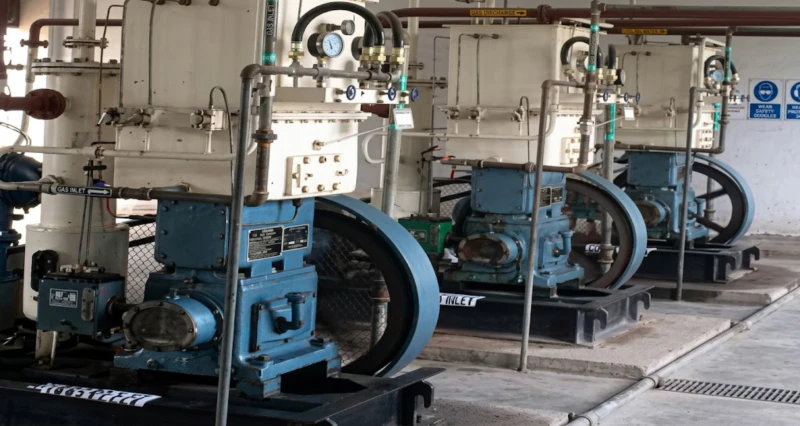
Installed at Customer Sites
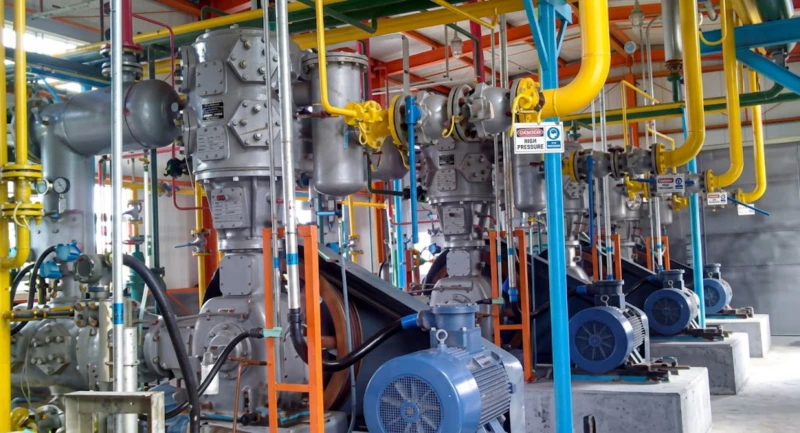
Acetylene compressors from this series are operating at dissolved acetylene cylinder filling stations, PVC and VAM chemical plants, and industrial gas distribution centres. The following images show representative customer site installations and maintenance operations.
How to Specify an Acetylene Compressor — Key Selection Criteria
Choose Series Based on Application
Series A (2.50 MPa) is for dissolved acetylene cylinder filling stations, high-pressure manifold supply, and any application requiring acetylene at 2.0 to 3.0 MPa. Series B (0.10 to 1.0 MPa) is for chemical process acetylene compression — PVC, VAM, acetaldehyde synthesis reactor feed, pipeline distribution, and any application where the downstream process pressure is below 1.0 MPa. Do not attempt to use a Series B model for cylinder filling or a Series A model as a direct chemical reactor feed compressor — the pressure ratings, stage configurations, and safety system settings are designed for their specific pressure range.
Specify VFD or Fixed-Speed Based on Generator Type
For dissolved acetylene plants where the acetylene generator output varies with carbide feed rate and operator attention — which describes most medium and small dissolved acetylene stations — the VFD model is strongly recommended. It prevents the inlet under-pressure risk, reduces gas waste from bypass relief, and extends piston ring life through smoother load transitions compared with fixed-speed unload-reload cycling. For large chemical plants where acetylene is produced continuously at constant rate by a well-controlled generator, fixed-speed models are acceptable and offer slightly lower capital cost.
Size Compressor Throughput to Generator Capacity
For dissolved acetylene filling stations, size the compressor throughput (m³/h) to match the generator rated capacity plus 15 to 20% margin. The generator rated capacity is its maximum sustained output in m³/h of acetylene. For VFD models, the minimum flow at lowest speed (approximately 50% of rated flow) must be above the minimum flow needed to keep the inlet buffer above atmospheric pressure. For chemical process applications, the compressor throughput must be sized for the peak process demand rate including start-up and turndown scenarios, not just the average steady-state rate.
Plan Safety Systems and Regulatory Compliance
Acetylene compressor installations are subject to national and local regulations covering explosive gas equipment, pressure vessel codes, and industrial gas plant safety. In China, acetylene compressors must be manufactured to GB standards for acetylene equipment, inspected by a qualified pressure vessel inspection authority before commissioning, and operated within a safety management system compliant with the Regulations on the Safety of Hazardous Chemicals. Our engineering team can provide the technical file, pressure vessel certificates, and material certification required for regulatory approval of each model. Review local regulatory requirements before specifying installation site layout, ventilation, gas leakage detection, and emergency shutdown systems.
Frequently Asked Questions — Acetylene Compressor
Ready to Specify an Acetylene Compressor for Your Plant?
Our application engineering team provides free acetylene compressor sizing, VFD versus fixed-speed recommendation, safety system specification, regulatory compliance documentation, and complete technical data sheets for both Series A and Series B. Factory-direct pricing, global export, custom design within 11 kW to 400 kW, and acetylene-service validated spare parts supply.