
Five Engineering Reasons This Technology Leads the Field in Oxygen Plant Compression
Not every compressed air application demands the same compressor technology. For general factory pneumatics, an oil-lubricated screw compressor is often the practical, cost-effective choice. For PSA and VPSA oxygen generation, however, the application imposes a specific and demanding combination of requirements — absolute oil-free air, stable mid-range pressure, continuous duty operation, energy efficiency, and low maintenance overhead — that converges on a single technology answer: the water-lubricated single-screw compressor.
This article explains the five core engineering advantages that make water-lubricated single-screw technology the preferred compressor choice for PSA oxygen duty. Each advantage is discussed with the technical depth needed to evaluate it against competing options — whether oil-lubricated screw, oil-free twin-screw, scroll, or reciprocating alternatives.
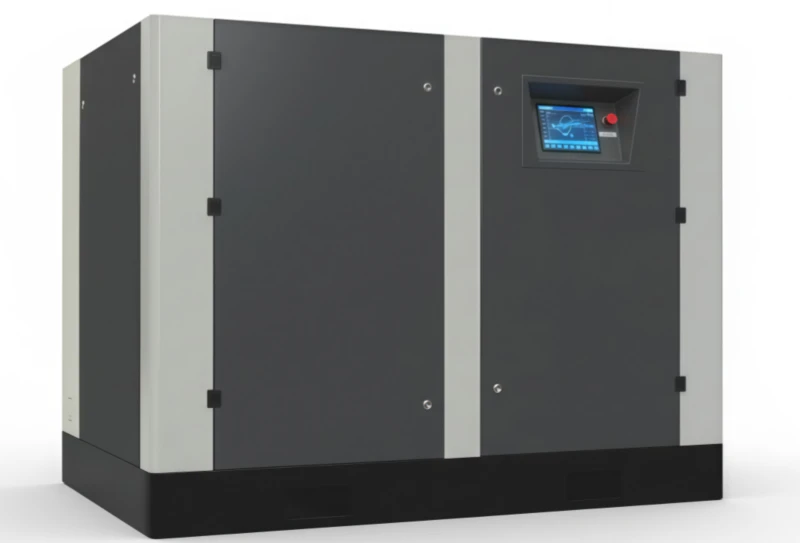
Categorical Class 0 Purity — by Engineering Design, Not by Filtration
The first and most fundamental advantage of water-lubricated single-screw technology is the categorical guarantee of ISO 8573-1 Class 0 compressed air purity. In a water-lubricated single-screw compressor, the compression chamber contains no oil — not as a sealing medium, not as a lubricant, not in any ancillary circuit with a fluid pathway to the compressed air stream. Pure water performs all three functions of sealing, cooling, and surface protection within the compression space. The result is a machine that is physically incapable of introducing hydrocarbon contamination into the compressed air discharge.
This distinction matters enormously for PSA oxygen plants because zeolite molecular sieve — the active separation medium in every PSA and VPSA generator — is irreversibly damaged by hydrocarbon contamination. Oil aerosols and vapours from conventional compressors coat the external surfaces of zeolite crystals and block the pore mouths through which nitrogen molecules must diffuse to be adsorbed. Once fouled, the zeolite cannot be regenerated to its original state by pressure-swing cycling alone. Replacement is the only remedy, at a cost that typically exceeds the original capital cost of the compressor.
Critical Distinction: Oil-free reciprocating compressors achieve oil-free cylinder compression — but still contain crankcase oil separated from the compression space by seals that degrade over time. Water-lubricated single-screw compressors contain no oil anywhere in the machine. Only the latter provides an unconditional Class 0 guarantee under all operating conditions throughout the full service life of the equipment.
For medical PSA oxygen stations, Class 0 is a mandatory regulatory requirement under EN ISO 7396-1 and the pharmacopoeial standards governing medical gas production. For industrial PSA oxygen plants, it is the engineering prerequisite for achieving the 10-year zeolite sieve service life on which the plant’s lifecycle economics are founded. In both contexts, the categorical purity guarantee of water-lubricated single-screw technology is not a luxury — it is the baseline requirement that the compressor specification must meet.
Near-Isothermal Compression — Lower Energy Consumption by Thermodynamic Design
The second core advantage is energy efficiency. Water-lubricated single-screw compression is near-isothermal — the water injected into the compression space throughout the compression stroke absorbs the heat of compression continuously, preventing the temperature rise that characterises adiabatic compression in dry machines. Because water has a specific heat capacity approximately 3,500 times greater than an equal mass of air, even a relatively small water-to-air mass ratio is sufficient to hold the gas temperature close to inlet conditions throughout compression.
The thermodynamic significance of this is direct: the work required to compress a gas isothermally is less than the work required to compress it adiabatically between the same pressure limits. For air compressed from atmospheric pressure to 7 bar gauge — the typical PSA feed air pressure — the theoretical isothermal work is approximately 18% lower than the adiabatic work. In practice, water-lubricated single-screw compressors achieve discharge temperatures of 40°C to 60°C above ambient, compared with 180°C to 220°C above ambient for single-stage oil-free reciprocating alternatives. This translates into specific energy savings of 8% to 18% over well-maintained multi-stage reciprocating units, and 20% to 35% when a permanent magnet variable frequency drive is combined with the single-screw unit to match output continuously to PSA system demand.
Theoretical energy saving — isothermal vs adiabatic at 7 bar
Energy saving vs fixed-speed reciprocating — single-screw with PMVFD
Share of lifetime cost accounted for by electricity
Max stable outlet pressure — single-stage water-lubricated single-screw
Because electricity represents approximately 60% of the total lifetime operating cost of a continuously running industrial compressor, a 20% energy reduction translates into a cost saving measured in tens of thousands of euros per year for a mid-size PSA installation. Over a 15-year plant life, this energy advantage alone typically recovers any capital cost premium between single-screw and alternative technologies.
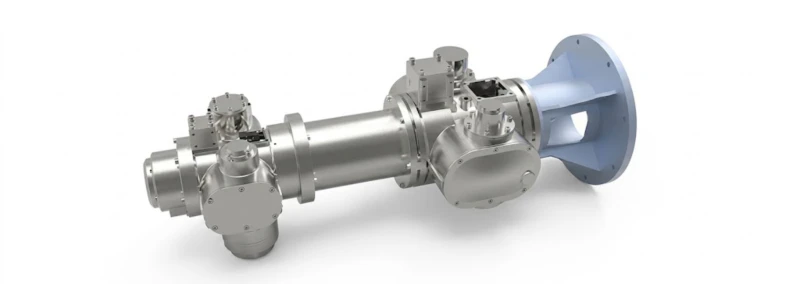
Inherent Force Balance — Extended Bearing Life Without Compromise
The third advantage is mechanical longevity, rooted in the unique force-balanced geometry of the single-screw architecture. The central main rotor meshes simultaneously with two gate rotors positioned on diametrically opposite sides, 180 degrees apart. The compression forces generated in the groove cavities on one side of the main rotor are exactly opposed by equal forces from the corresponding cavities on the other side. The net radial force acting on the main rotor bearings during steady-state operation therefore approaches zero — a structural property unique to the single-screw design among all positive displacement compressor geometries.
Rolling element bearing fatigue life varies with applied load raised to the power of 3 for ball bearings — halving the bearing load extends calculated life eightfold. Single-screw compressor main bearings, operating at a fraction of the loads seen in reciprocating or twin-screw alternatives, routinely achieve inspection intervals of 40,000 to 60,000 operating hours. This compares with 16,000 to 24,000 hours between bearing replacements for equivalent oil-free reciprocating units. For a continuously operating PSA plant, this difference means one bearing overhaul every 5 to 7 years versus one every 2 to 3 years — a significant reduction in planned downtime and maintenance resource commitment.
Combined with the complete absence of air valves and piston rings — the two most maintenance-intensive wear items in reciprocating compressors — the force-balanced single-screw design produces a maintenance profile that is qualitatively simpler and quantitatively less costly than any reciprocating alternative of comparable capacity and pressure rating.
No Air Valves, No Piston Rings — Eliminating the Recurring Failure Modes
The fourth advantage is the complete elimination of the two components that generate the majority of unplanned downtime and scheduled maintenance cost in reciprocating compressor installations: air valves and piston rings.
In a reciprocating compressor running at 1,000 rpm, each suction and discharge valve opens and closes 60,000 times per hour. Over a year of continuous operation, this accumulates to over 500 million valve actuation cycles per valve assembly. The fatigue cracking that results from this cycling is statistically inevitable — standard replacement intervals of 4,000 to 8,000 hours mean two to four valve replacement operations per year for a continuously running machine, each requiring compressor shutdown and partial disassembly. The oil-free PTFE-composite piston rings wear progressively against the cylinder bore, requiring replacement every 8,000 to 16,000 hours as blow-by losses increase beyond acceptable limits.
The single-screw geometry has no intake or discharge valves — gas flow direction is controlled entirely by the rotational geometry of the rotor and fixed port positions. There are no piston rings, no crosshead guides, and no components subject to the cyclic wear mechanisms that drive reciprocating compressor maintenance schedules. The primary service items are water circuit maintenance and periodic bearing inspection at the extended intervals described above. For plant operators, this reduction in maintenance frequency translates directly into higher compressor availability, lower planned downtime, and a significantly smaller spare parts inventory requirement.
Operational Impact: In a PSA oxygen plant serving a continuous industrial process — an electric arc furnace, a hospital medical gas pipeline, or a large fermentation facility — an unplanned compressor shutdown caused by valve failure interrupts oxygen supply with immediate process consequences. The valve-free design of single-screw compressors eliminates this entire failure mode, directly improving supply reliability for downstream processes that depend on uninterrupted oxygen delivery.
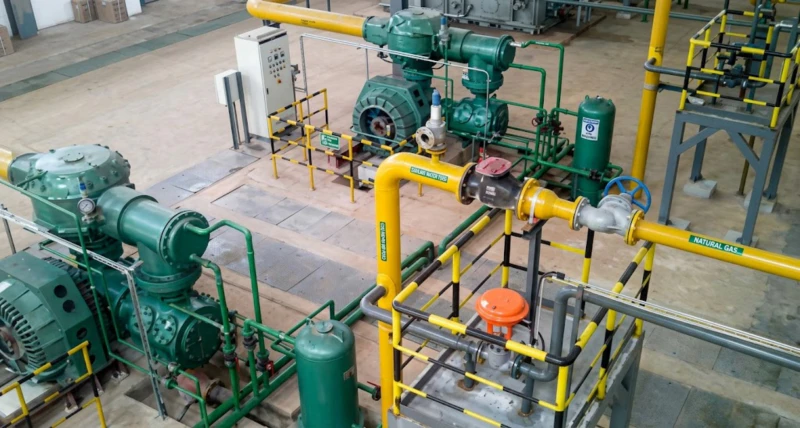
Stable Pressure to 40 Bar — Single-Stage Capability That Covers All PSA Ranges
The fifth advantage is pressure range coverage. Water-lubricated single-screw compressors can deliver stable discharge pressures up to 40 bar gauge from a single compression stage — a range that encompasses every PSA oxygen generation application from standard 5 to 7 bar feed air through to oxygen cylinder filling booster feed applications at 15 to 25 bar, and even some specialised high-pressure industrial oxygen applications.
The structural basis for this high single-stage pressure capability is again the force-balanced geometry. In a conventional twin-screw compressor, the pressure ratio achievable in a single stage is limited by the rotor deflection and bearing loads that result from the net gas pressure forces acting on the asymmetric rotor geometry. Increasing the pressure ratio in a twin-screw requires either reducing the rotor length-to-diameter ratio (limiting flow capacity) or accepting higher bearing loads that shorten service life. The single-screw geometry, with its inherently zero net radial force, is not subject to this constraint — higher pressure ratios do not increase the net bearing load, allowing single-stage operation at pressure ratios that require multi-stage configurations in alternative compressor designs.
For PSA oxygen plants, this translates into practical flexibility: the same compressor platform can serve both standard PSA feed air duty at 5 to 7 bar and oxygen booster pre-compression at 15 to 25 bar, simplifying the equipment selection process and creating opportunities for standardisation across a facility’s compressor fleet. Oil-free twin-screw compressors are typically limited to 4 to 5 bar gauge in single-stage configurations, and oil-free scroll compressors reach 8 to 10 bar at most — neither covers the full pressure range that single-screw technology achieves in a single stage.
How Single-Screw Compares Against All Major Oil-Free Alternatives
The five advantages discussed above position water-lubricated single-screw technology clearly relative to the other oil-free compressor types that might be considered for PSA oxygen duty.
| Parameter | Water-Lubricated Single-Screw | Oil-Free Twin-Screw | Oil-Free Reciprocating | Oil-Free Scroll |
|---|---|---|---|---|
| ISO Class 0 Guarantee | Categorical — no oil in machine | Class 0 achievable — gearbox oil present, seals required | Class 1 typical — crankcase oil, seal degradation risk | Oil-free compression — Class 0 achievable at small scale |
| Compression Efficiency | Near-isothermal — best efficiency | Near-adiabatic — intercooling required at higher pressure | Adiabatic — multi-stage with intercoolers needed | Near-isothermal at small scale — efficiency drops with size |
| Air Valves | None | None | Yes — major maintenance item every 4,000–8,000 hr | None — tip seal wear instead |
| Bearing Load | Near-zero net radial — longest life | Moderate — asymmetric rotor forces present | High cyclical and impulsive — shortest life | Low at small scale — limited to small units |
| Max Single-Stage Pressure | Up to 40 bar | 4–5 bar typical | 7–10 bar per stage | 8–10 bar max |
| Vibration Level | Very low — 60–70 dB(A) | Low — similar to single-screw | High — 75–85 dB(A); acoustic enclosure often needed | Very low — but limited to small capacities |
| Suitable Flow Range for PSA | 20–3,000+ Nm³/h feed air | 50–500 Nm³/h — limited pressure range | 5–500 Nm³/h — high maintenance at upper end | 5–50 Nm³/h — small scale only |
System Configurations: Air-Cooled and Water-Cooled for Different Site Contexts
Water-lubricated single-screw compressors for PSA oxygen duty are available in two cooling configurations, each suited to different installation contexts. The choice between them affects installation cost, footprint, and performance under high-ambient-temperature conditions.
Air-cooled configurations are fully self-contained units equipped with fan-driven heat exchangers that dissipate compression heat to the ambient air. They require no external cooling water supply or cooling tower infrastructure, making them the preferred choice for standalone oxygen plants, remote installations, and healthcare facilities where cooling water is not available. Air-cooled units are simpler to install and commission, with lower ancillary infrastructure cost. Their primary limitation is sensitivity to high ambient temperatures, which reduces volumetric capacity and must be accounted for in sizing calculations for hot-climate or summer-peak installations.
Water-cooled configurations use an external cooling water circuit — connected to a cooling tower, chilled water system, or process cooling loop — to remove compression heat. They achieve slightly higher energy efficiency through more effective isothermal compression conditions, and their performance is less sensitive to ambient temperature variation. For large industrial PSA plants where cooling water infrastructure is already available, water-cooled configurations are the preferred specification for optimal long-term efficiency.
Selecting the Right Unit: Key Parameters to Define Before Enquiring
When approaching a supplier for a water-lubricated single-screw compressor for PSA oxygen duty, defining the following parameters correctly before the initial enquiry ensures that the quotation received is matched to the actual application requirements — avoiding the costly mismatches that arise from under-specified or reference-condition-only sizing.
- Required feed air flow rate (Nm³/h) at the PSA generator inlet pressure, stated at actual site ambient conditions (temperature and altitude), not at standard reference conditions. Include a minimum 15% margin for sieve ageing and future demand growth.
- Required discharge pressure (bar gauge) at the compressor outlet — typically 7 to 8 bar gauge for standard PSA feed air, to maintain 5 to 7 bar at the generator inlet after treatment train pressure losses.
- Drive configuration preference — permanent magnet variable frequency drive (PMVFD) for applications with variable oxygen demand (recommended for most PSA plants), or fixed-speed industrial frequency motor for applications with stable, constant demand.
- Cooling configuration — air-cooled (self-contained, no cooling water required) or water-cooled (higher efficiency, external cooling circuit required).
- Certification requirements — ISO 8573-1 Class 0 certificate, CE marking, IQ/OQ documentation for medical or pharmaceutical applications, or other regulatory documentation required by the facility’s compliance framework.
Procurement teams that specify these parameters precisely — and that engage with a specialist single screw compressor for oxygen plant supplier from the project definition stage — consistently achieve better equipment-to-application fit, fewer post-installation modifications, and lower total lifecycle cost than teams that treat compressor selection as a commodity procurement decision.
Conclusion: Five Advantages That Add Up to One Clear Technology Choice
Water-lubricated single-screw compressors do not win the PSA oxygen plant compressor specification on any single parameter — they win on all five simultaneously. Categorical Class 0 purity eliminates the zeolite contamination risk. Near-isothermal compression delivers the lowest specific energy consumption of any oil-free positive displacement technology at PSA pressure ratios. Inherent force balance produces the lowest bearing loads and longest overhaul intervals. Valve-free rotary operation eliminates the recurring failure mode that dominates reciprocating compressor maintenance schedules. And single-stage pressure capability to 40 bar covers every PSA application range without multi-stage complexity.
For plant engineers and procurement managers evaluating compressor options for new PSA oxygen installations, or reviewing the replacement of existing equipment, the technical and economic case for water-lubricated single-screw technology is well-established across thousands of installations in medical, industrial, and environmental applications worldwide. Engaging with a specialist PSA oxygen plant air compressor supplier at the project definition stage ensures the correct unit specification, appropriate certification documentation, and application engineering support needed to deploy these advantages fully in a specific installation context.
Specify a Water-Lubricated Single-Screw Compressor for Your PSA Oxygen Plant
Our engineering team provides Class 0 certified water-lubricated single-screw compressors in air-cooled and water-cooled configurations, with permanent magnet VFD options and full certification documentation for PSA and VPSA oxygen generation projects. Local stock and rapid technical service for Russia and CIS markets.
Request a Technical Consultation
Browse Our Air Compressor Range