
Why PET Bottle Blowing Demands a Compressor Specification Unlike Any Other Packaging Application
PET stretch blow molding is one of the most demanding compressed air applications in the packaging industry. The process requires air at pressures between 25 bar and 40 bar — far above the 6 to 10 bar that serves most other factory pneumatic needs — delivered in precisely timed high-flow pulses that must be synchronized with machine cycles running at up to 2,000 bottles per hour per cavity. The air must be absolutely oil-free, dry, and particle-free, because it enters directly into the interior of the bottle being formed and any contamination becomes contamination of the food or beverage contact surface of that bottle.
These three requirements — high pressure, high flow, and guaranteed purity — converge on a compressor specification that cannot be met by standard industrial screw compressors, oil-lubricated reciprocating units, or general-purpose high-pressure machines. They demand a dedicated high-pressure oil-free compressor designed specifically for PET blow molding service. Understanding why each requirement exists, and how correctly specified compressor equipment meets it, is the starting point for anyone responsible for specifying, operating, or troubleshooting compressed air systems on a PET packaging line.
The PET Stretch Blow Molding Process: What Compressed Air Is Actually Doing
Understanding the compressed air role in PET bottle production requires a brief look at the stretch blow molding process itself. A PET preform — a thick-walled tube of polyethylene terephthalate resin, roughly test-tube shaped — is heated to its glass transition temperature (approximately 95°C to 110°C) in an infrared oven. At this temperature, the PET becomes pliable and capable of being deformed without cracking. The heated preform is then transferred into a mold shaped as the final bottle.
Inside the mold, a stretch rod extends downward through the preform neck, mechanically stretching the softened PET toward the base of the mold in the axial direction. Simultaneously, a first blast of compressed air at low pressure (typically 8 to 12 bar) begins inflating the preform radially, expanding it against the mold walls. This is the pre-blow stage. A second, higher-pressure air blast then follows immediately — at 25 to 40 bar — forcing the PET film tightly against every surface of the mold cavity to create the precise final bottle geometry. This is the main blow stage. The high pressure is essential: at lower pressures, the PET does not conform fully to the mold geometry, producing bottles with uneven wall thickness, reduced top-load strength, and dimensional inconsistency that cause downstream filling line problems.
After the main blow, the air pressure is maintained briefly to allow the PET to cool and set against the mold surface, then exhausted through a muffler as the mold opens and the finished bottle is ejected. The entire blow cycle from mold close to bottle ejection takes 1.5 to 3 seconds depending on bottle size and machine speed. Each cycle consumes a precisely defined volume of high-pressure air that must be replenished by the compressor between cycles to maintain stable pressure in the high-pressure reservoir feeding the blow station.
Process Significance: The compressed air in a PET stretch blow molding machine is not merely a utility — it is a forming tool. The pressure profile, flow rate, and timing of the pre-blow and main blow air pulses directly determine bottle wall thickness distribution, material orientation, and the mechanical properties of the finished container. Inconsistent compressor performance translates directly into bottle quality variation that affects downstream filling, capping, and labelling line performance.
Pre-blow air pressure — initial radial expansion stage
Main blow air pressure — final mold conformance stage
Full blow cycle time per bottle cavity
Bottles per hour on high-speed multi-cavity machines
Why Oil-Free Air Is Non-Negotiable for Food and Beverage PET Containers
The high-pressure main blow air enters the interior of the bottle being formed and contacts the inner wall surface that will subsequently be in direct contact with the beverage, water, juice, edible oil, or food product the bottle is designed to contain. Any oil aerosol or vapour present in the blow air deposits on this interior surface during the forming process — a deposit that cannot be removed by subsequent rinsing or sterilisation procedures because it occurs during the bottle formation itself, before the bottle is even removed from the mold.
Oil contamination on the interior surface of a PET beverage bottle constitutes adulteration of the food-contact surface. In most regulatory jurisdictions, food-contact materials are governed by specific regulations — EU Regulation 10/2011 on plastic materials in contact with food, US FDA 21 CFR Part 177, and equivalent national standards — that prohibit the transfer of hazardous substances from packaging materials into food products above defined migration limits. Compressor lubricating oil, which is a complex mixture of hydrocarbons, additives, and degradation products, is not an approved food-contact substance under these frameworks.
Beyond regulatory compliance, oil contamination on PET bottle interior surfaces has practical consequences for beverage quality: it causes off-flavours and odours detectable by consumers at very low concentrations, affects the carbonation retention of sparkling beverages by altering the surface chemistry of the polymer, and can cause premature delamination or stress cracking of the bottle wall in some product compositions. For brand owners whose product quality reputation depends on consistent sensory characteristics, the risk associated with using oil-lubricated blow molding compressors is simply not acceptable.
Why Downstream Filtration Is Insufficient
At the 25 to 40 bar operating pressure of PET blow molding air systems, downstream oil mist filtration faces a fundamental limitation: oil vapour — the gaseous phase fraction of compressor lubricating oil volatilised under the high temperatures of compression — is molecularly dispersed and passes through all coalescing and particulate filter media with essentially zero removal efficiency. Even the most sophisticated high-pressure filtration system provides no protection against oil vapour contamination, and the only engineering solution that eliminates this risk is a compressor that contains no lubricating oil within the compression chamber.
High-Pressure Oil-Free Compressor Technology for PET Blow Molding
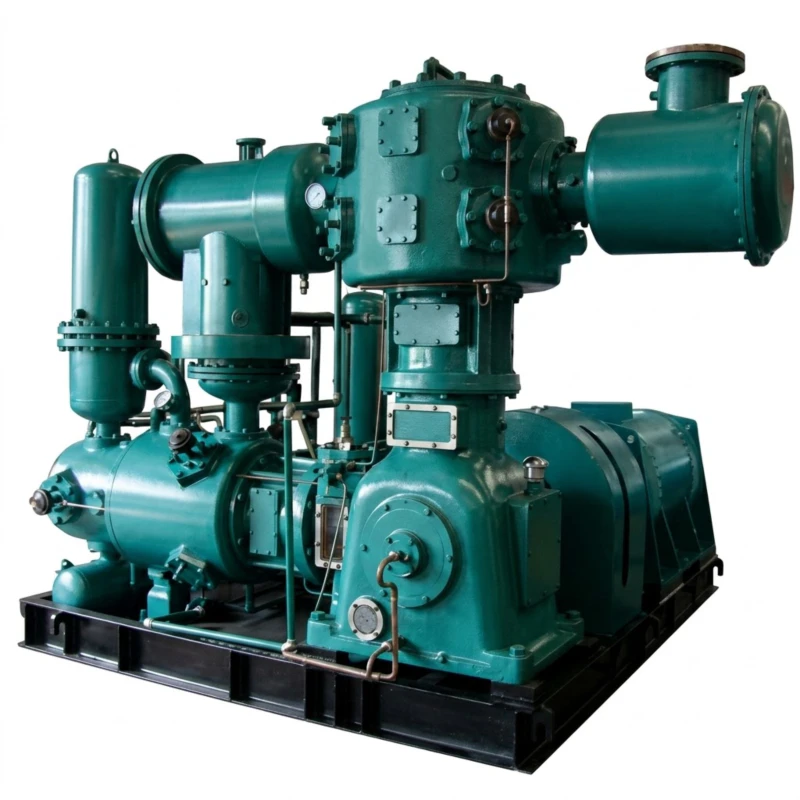
High-pressure oil-free compressors for PET stretch blow molding are a specialised product category distinct from the standard 6 to 10 bar oil-free compressors used for general industrial and medical compressed air applications. They must deliver oil-free air at 25 to 40 bar — a pressure ratio of 25:1 to 40:1 relative to atmospheric inlet conditions — which requires a multi-stage compression architecture with intercooling between stages to manage the heat of compression and maintain acceptable discharge temperatures and volumetric efficiencies at each stage.
Multi-Stage Compression with Intercooling
A typical high-pressure oil-free compressor for PET blow molding duty uses three compression stages: a first stage compressing from atmospheric to approximately 4 to 6 bar, a second stage compressing to approximately 12 to 16 bar, and a third stage compressing to the final delivery pressure of 25 to 40 bar. Between each stage, the compressed air passes through an intercooler that removes the heat generated by compression, reducing the inlet temperature of the next stage to near-ambient conditions. This intercooled multi-stage approach significantly reduces the total compression work compared with single-stage compression to the same final pressure, and keeps the discharge temperature of each stage within the limits of the oil-free piston ring and cylinder liner materials.
Permanent Magnet Variable Frequency Drive for Packaging Line Efficiency
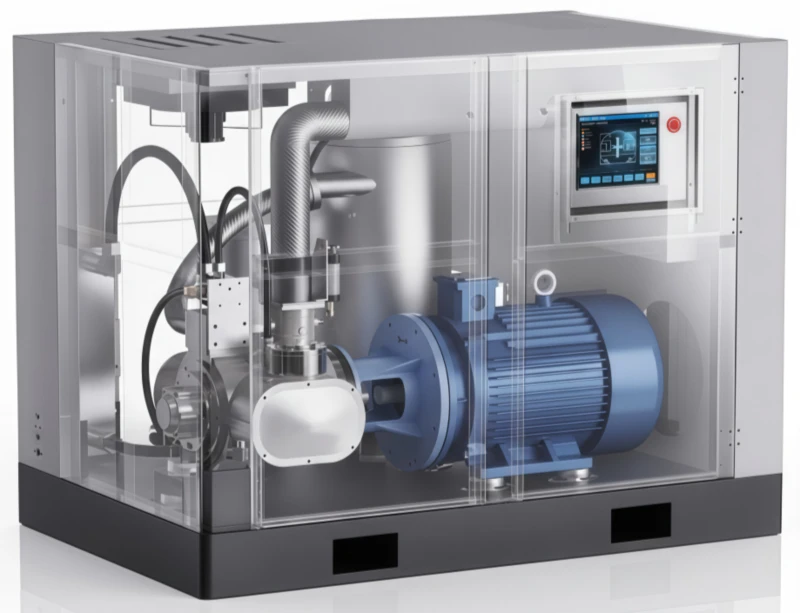
Modern high-pressure oil-free compressors for PET blow molding are increasingly equipped with permanent magnet synchronous motors driven by variable frequency inverters. PET blow molding lines do not operate at constant air demand — production scheduling creates periods of full-speed operation, reduced-speed operation, and planned stoppages for mold changes, preform replenishment, and shift breaks. A variable frequency drive allows the compressor to modulate its output continuously in response to actual demand, avoiding the energy waste of off-loading or pressure-band cycling that characterises fixed-speed compressor operation on variable-demand applications. For high-pressure compressors where the motor power consumption is substantial, the energy saving from variable frequency operation is significant in absolute terms over a packaging line’s annual operating hours.
Direct-Coupled Drive: Eliminating Belt and Gear Transmission Losses
High-efficiency PET blow molding compressors use direct-coupled drive arrangements — the motor shaft is directly connected to the compressor crankshaft through a flexible coupling, eliminating the transmission losses associated with belt drives (typically 3% to 5% power loss) or gear trains (2% to 4% power loss). Direct coupling also eliminates the belt tensioning, belt replacement, and pulley alignment maintenance requirements of belt-driven alternatives, reducing maintenance workload on high-utilisation packaging line compressor installations.
Compressed Air Treatment Requirements for PET Blow Molding
Beyond the compressor itself, the compressed air treatment train between the compressor and the blow molding machine must be correctly designed to deliver air meeting the quality specifications of the blow molding machine manufacturer. The key treatment requirements for PET blow molding compressed air are moisture removal, particulate filtration, and — for food-grade applications — verification of zero oil content.
Moisture Removal
Moisture in the high-pressure blow air can cause two problems: condensation inside the blow mold tooling, which promotes corrosion of the mold steel and interferes with the PET forming process, and surface defects on the bottle interior wall caused by water droplets impacting the hot PET during forming. A refrigerant dryer rated for the high-pressure operating conditions (most refrigerant dryers are rated for maximum pressures of 10 to 16 bar — a high-pressure dryer rated to 40 bar is required for PET blow molding service) reduces the pressure dew point to +3°C. For bottle applications where additional moisture protection is required, a desiccant stage can be added downstream to achieve −40°C PDP.
Particulate Filtration
High-pressure filtration at 1 micron and 0.01 micron removes any particulate matter — including desiccant fines, pipe scale, and airborne dust — that could cause visible contamination on the interior bottle wall or damage the precision-machined blow valve seats in the blow molding machine. High-pressure filter housings rated to 40 to 50 bar with stainless steel elements are required — standard 10 bar industrial filter housings are not suitable for PET blow molding service.
High-Pressure Distribution Pipework
The high-pressure distribution system connecting the compressor to the blow molding machine must be designed and pressure-tested for the full operating pressure. Stainless steel tubing or high-pressure rated aluminium pipe is standard for food-grade PET facilities — copper is not recommended due to its reactivity with moisture and its tendency to produce blue-green corrosion products at elevated pressures. All joints must be flanged or compression-fittings rated for 40 bar minimum; push-in pneumatic fittings suitable for low-pressure systems are not appropriate for high-pressure blow molding circuits.
Common Specification Error: Using standard 10 bar rated compressed air treatment equipment — dryers, filters, pressure vessels — on PET blow molding high-pressure circuits. All treatment equipment must carry pressure ratings compatible with the system’s operating pressure. Installing under-rated equipment creates both a performance risk (collapsed filter elements) and a safety risk (pressure vessel failure) that are entirely avoidable through correct specification from the outset.
Sizing the Blow Molding Compressor: Flow Rate, Pressure, and Duty Cycle Calculation
Correct compressor sizing for a PET blow molding line is more complex than for most compressed air applications because the demand is highly pulsed — each bottle blow cycle consumes a large volume of high-pressure air in a very short time, then demand drops to near-zero during the mold-open and bottle-ejection phases. The compressor and high-pressure reservoir together must be sized to supply the peak instantaneous demand without unacceptable pressure drop, while the compressor’s average output capacity must match the average air consumption over a complete production cycle.
Calculating Average Air Consumption
The average air consumption of a PET blow molding machine can be estimated from the bottle volume, the operating pressure, and the production rate. A 1.5-litre PET bottle blown to 30 bar, with a 2-second blow cycle and 50% blow time fraction, consumes approximately 0.45 litres of free air (at atmospheric conditions) per bottle at the main blow stage. For an 8-cavity machine producing 6,000 bottles per hour (750 per cavity per hour), this amounts to approximately 270 litres per minute of free air — or roughly 16 Nm³/h of continuous compressor output requirement. In practice, compressor sizing should add 20% to 30% above this calculated average to account for air circuit leakage, blow valve purge flows, and production ramp-up peaks.
High-Pressure Reservoir Sizing
The high-pressure reservoir (accumulator) between the compressor and the blow molding machine dampens the pressure pulsations from the blow cycle and ensures that the compressor is not required to deliver instantaneous peak flows that greatly exceed its rated capacity. Reservoir volume is typically sized to provide 3 to 5 seconds of average consumption at the operating pressure, which limits pressure drop during each blow cycle to an acceptable range — typically less than 1 to 2 bar variation around the set pressure. Undersized reservoirs cause excessive pressure cycling that stresses the compressor’s unloading mechanism and can cause bottle quality inconsistency from pressure variation between successive blow cycles.
Integrating the Blow Molding Compressor with a Complete Packaging Line Solution
For packaging manufacturers seeking a fully integrated solution, the high-pressure blow molding compressor is one element of a broader equipment package that includes the stretch blow molding machine itself. Suppliers who can provide both the compressor and the blow molding machine as a matched, pre-engineered system offer significant advantages over assembling these components independently from different vendors.
A matched compressor-machine package ensures that the compressor’s pressure-flow characteristics are optimised for the specific blow molding machine’s demand profile, that the high-pressure distribution circuit is pre-engineered with correctly rated components, and that the electrical interface between the compressor control system and the machine PLC is designed for coordinated operation. This integration eliminates the finger-pointing between equipment suppliers that commonly occurs when a packaging line compressed air system underperforms — each supplier pointing to the other’s equipment as the source of the problem.
For packaging manufacturers evaluating complete line solutions, the combination of a high-pressure oil-free PET blow molding air compressor with a matched high-speed injection blow molding machine from the same supplier family represents the most reliable path to rapid commissioning, consistent bottle quality, and predictable long-term line availability.
Key Specification Parameters for PET Blow Molding Compressor Selection
Specifying a high-pressure oil-free compressor for a PET blow molding line requires defining a set of parameters that differs significantly from standard compressed air applications — principally because of the high operating pressure and the direct food-contact purity requirement.
- Final delivery pressure (bar gauge) at the blow molding machine inlet — typically 30 to 40 bar for most PET bottle sizes. Verify with the blow molding machine manufacturer’s specification, not a generic industry estimate.
- Required flow rate (Nm³/h) calculated from the machine’s bottle production rate, bottle volume, and blow cycle parameters, plus a 25% margin for circuit leakage and production peaks.
- Oil-free certification — ISO 8573-1 Class 0 for oil content is the mandatory baseline. For food and beverage applications, additional food-grade compliance documentation may be required by the brand owner or retailer audit standards.
- Drive configuration — permanent magnet VFD strongly preferred for energy efficiency on lines with variable production schedules. Fixed-speed units acceptable only for continuous, single-speed production operations.
- Cooling configuration — air-cooled self-contained units for compact line installations; water-cooled for large-scale facilities where cooling water infrastructure is available and where energy efficiency at sustained high loads is the priority.
- Downstream treatment equipment pressure ratings — all dryers, filters, and pressure vessels in the high-pressure circuit must carry pressure ratings appropriate for the operating pressure, with a minimum safety factor of 1.5 times the maximum working pressure.
Packaging engineers who work with a specialist air compressor for PET bottle blowing supplier at the line design stage — rather than treating the compressor as a commodity item specified by catalogue — consistently achieve better pressure stability, more reliable food-grade compliance, and lower total energy consumption over the packaging line’s operational life.
Conclusion: High-Pressure Oil-Free Compression Is the Only Acceptable Specification for PET Packaging
PET stretch blow molding imposes a unique combination of compressed air requirements that no other packaging application shares: very high pressure (25 to 40 bar), guaranteed oil-free purity for food-contact surface compliance, and the flow stability needed for consistent bottle quality at high production speeds. These three requirements jointly define a compressor specification that only dedicated high-pressure oil-free units can meet.
For packaging engineers evaluating new line installations or reviewing the performance of existing compressed air systems, the investment case for correctly specified high-pressure oil-free compression is straightforward: it eliminates food-contact contamination risk and regulatory exposure, protects bottle quality consistency, and — when combined with permanent magnet variable frequency drive technology — delivers the energy efficiency that makes large-scale PET bottle production economically sustainable. Engaging with a specialist supplier at the project definition stage provides the application engineering expertise needed to size, specify, and integrate the compressor correctly within the complete packaging line system.
Specifying a High-Pressure Compressor for Your PET Blow Molding Line?
Our engineering team provides oil-free high-pressure compressors for PET stretch blow molding with permanent magnet VFD options, food-grade certification documentation, and integrated packaging line compressor-machine solutions. Local stock and rapid technical service for Russia and CIS markets.
Request a Technical Consultation
Browse Our Air Compressor Range