
Electricity Is 60% of Your Oxygen Plant’s Lifetime Cost — Here Is How to Reduce It
For any continuously operating industrial compressed air or oxygen generation installation, electricity is not merely a significant cost — it is the dominant cost. Across the typical 15 to 20-year operational life of a PSA or VPSA oxygen plant, electricity consumption by the feed air compressor accounts for approximately 60% of the total lifecycle expenditure. Maintenance represents around 30%, and the original capital cost of the compressor — the figure that most often drives purchasing decisions — accounts for only 10%. A compressor that costs 20% more to purchase but consumes 20% less electricity over 15 years does not merely pay back its premium; it delivers net savings that substantially exceed the purchase price differential.
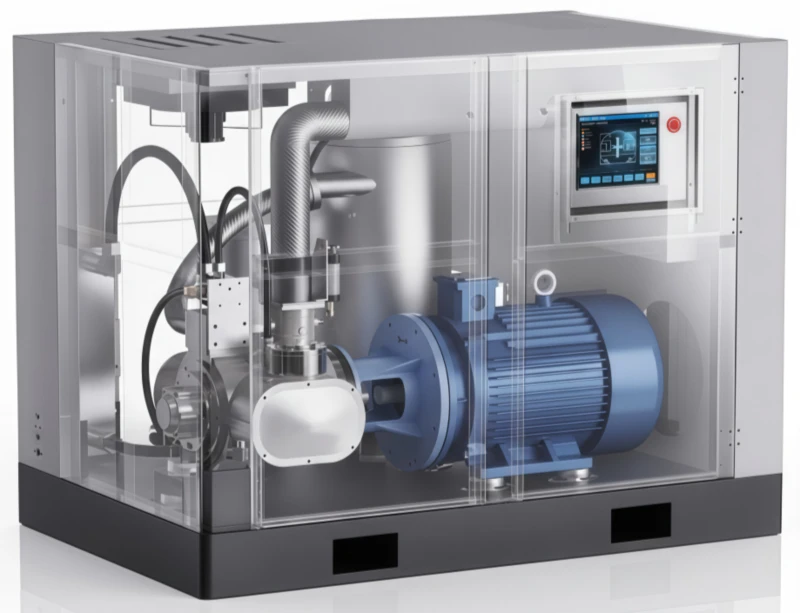
The technology that most directly addresses this electricity cost dominance is the permanent magnet variable frequency drive (PMVFD) compressor — a unit in which a permanent magnet synchronous motor (PMSM), controlled by a variable frequency inverter, continuously modulates the compressor speed to match the actual compressed air demand of the PSA system at any given moment. This speed modulation eliminates the two largest sources of energy waste in fixed-speed compressor operation: off-load running and pressure-band cycling. When combined with the inherent near-isothermal efficiency of water-lubricated single-screw compression, PMVFD technology delivers the lowest achievable specific energy consumption for PSA oxygen plant feed air compression across all production scales.
Why PSA Oxygen Systems Have Variable Compressed Air Demand
To understand why variable frequency drive technology delivers such significant energy savings in PSA oxygen plant applications, it is necessary first to understand the demand profile that the compressor is serving. PSA oxygen generators do not draw compressed air at a constant rate — the cyclic nature of the adsorption-regeneration process creates a pulsating demand pattern that varies significantly around the average.
In a standard PSA cycle, the adsorbing column draws feed air at high flow rate during the pressurisation and production phases. When the cycle switches — the producing column enters depressurisation and regeneration, while the regenerated column begins its pressurisation phase — the instantaneous air demand changes rapidly. A buffer vessel between the compressor and the PSA generator dampens these pulsations, but the compressor must still respond to the time-averaged demand variation across multiple cycle sequences. Additionally, most real oxygen plants do not operate at constant oxygen demand — production scheduling, process variation, and time-of-day demand patterns all create sustained periods where the PSA system operates below its rated capacity, requiring proportionally less compressed air than at full output.
A fixed-speed compressor has only two response options to reduced demand: it either continues running at full speed and dumps the excess compressed air through an unloading valve (wasting the energy that was used to compress it), or it cycles off and on repeatedly to match average demand (causing mechanical stress from repeated starts and pressure fluctuations in the supply header). Both responses waste energy and impose operating costs that a variable frequency drive compressor entirely avoids.
The Core Insight: A variable frequency drive compressor does not choose between running at full output or stopping — it runs continuously at whatever speed delivers exactly the compressed air flow the system needs at every moment. This eliminates both the wasted energy of off-load running and the mechanical damage of frequent starts, simultaneously reducing electricity costs and extending compressor service life.
Permanent Magnet Synchronous Motors: Why They Outperform Standard Induction Motors
Variable frequency drives can be paired with either standard induction motors or permanent magnet synchronous motors (PMSMs). For PSA oxygen plant compressor duty, permanent magnet motors represent a significant performance advantage that justifies the modest additional investment over standard induction motor alternatives.
High Efficiency Across the Full Speed Range
Standard induction motors achieve their peak efficiency at or near their rated full-load speed. As speed is reduced by the variable frequency drive — which is precisely the operating mode during partial load conditions — induction motor efficiency drops significantly, particularly at speeds below 50% of rated. This efficiency loss partially offsets the energy saving from reduced compression work at partial load. Permanent magnet synchronous motors, by contrast, maintain high efficiency across the full operating speed range, from near-zero to full rated speed. This is because the magnetic flux in a PMSM is provided by the permanent magnets in the rotor rather than by induction currents — there are no rotor copper losses (the primary source of speed-dependent efficiency loss in induction motors), and motor efficiency remains near its peak value even at low speeds and loads.
Higher Power Factor Across All Operating Points
Induction motors draw reactive power from the electrical supply to establish the magnetic field in the rotor, resulting in a power factor below unity — often as low as 0.7 to 0.8 at partial load. Poor power factor increases the current drawn from the supply for a given mechanical power output, which in some industrial tariff structures results in demand charge penalties. Permanent magnet motors operate at near-unity power factor across all load conditions because the rotor magnetic field is established by the permanent magnets rather than by reactive current from the supply. For large oxygen plant compressors, the elimination of reactive power demand can provide a measurable reduction in electricity tariff charges in addition to the direct energy saving from reduced compression work.
Compact Form Factor for Direct-Coupled Integration
Permanent magnet motors produce higher torque density than equivalent induction motors — more torque per unit of motor volume and weight. This allows PMSM-driven compressors to be more compact than induction motor equivalents at the same rated power, and facilitates direct coupling between the motor shaft and the compressor shaft without intermediate gearbox or belt transmission. Direct coupling eliminates transmission losses (3% to 5% for belt drives, 2% to 4% for gearboxes) and removes the belt tensioning and replacement maintenance requirements of belt-driven compressor configurations.
Energy saving vs fixed-speed compressor — PMVFD single-screw on PSA duty
Speed modulation range — PMVFD single-screw vs 50–100% limit for reciprocating
Share of compressor lifecycle cost represented by electricity
Typical payback period for PMVFD premium vs fixed-speed at industrial electricity rates
The Combined Efficiency Advantage: PMVFD Plus Water-Lubricated Single-Screw
The energy efficiency advantages of PMVFD technology and water-lubricated single-screw compression are independent but compounding. Each delivers a separate reduction in specific energy consumption, and their combination produces the lowest achievable specific energy for oil-free compressed air at PSA oxygen plant feed pressures.
Water-lubricated single-screw compression reduces the thermodynamic work required to compress air from atmospheric to operating pressure by approaching isothermal compression conditions. As described in earlier articles in this series, water injection into the compression chamber absorbs heat throughout the compression stroke, limiting the gas temperature rise and reducing the specific compression work relative to the adiabatic process of dry compressors. For air compressed to 7 bar gauge, the near-isothermal process of water-lubricated single-screw compression requires approximately 8% to 18% less shaft power than an equivalent adiabatic process in a dry oil-free compressor.
PMVFD speed modulation then eliminates the energy waste of fixed-speed operation at partial load. Because the single-screw compressor’s shaft power requirement scales approximately with the cube of rotor speed at constant pressure ratio (following the affinity laws for rotary displacement machines), reducing speed to 80% of rated reduces shaft power to approximately 51% of rated — a 49% reduction in power for a 20% reduction in flow. In practice, the relationship is not perfectly cubic because pressure ratio effects modify the theoretical affinity law relationship, but the directional effect is powerful: at partial load, the PMVFD single-screw combination draws dramatically less power than a fixed-speed unit at the same output condition.
Quantifying the Energy Saving: A Representative Case Study
The energy saving from PMVFD technology is not a theoretical claim — it is a measurable, verifiable operational outcome that can be calculated from plant operating data with reasonable accuracy. The following representative example illustrates the scale of the saving for a mid-size industrial PSA oxygen plant.
Consider a PSA oxygen plant producing 100 Nm³/h of oxygen at 93% purity, fed by a water-lubricated single-screw compressor delivering 380 Nm³/h of feed air at 7 bar gauge. The compressor has a rated shaft power of 55 kW at full load. The plant operates 8,000 hours per year, but analysis of the oxygen demand profile shows that average oxygen demand over the year is 78% of rated capacity — the plant runs at partial load for a significant proportion of its operating hours due to production scheduling variation.
With a fixed-speed compressor, average electrical consumption is approximately 85% of rated motor power during loaded operation (accounting for motor and drive losses) — approximately 47 kW average. Over 8,000 hours, annual electricity consumption is approximately 376,000 kWh.
With a PMVFD compressor operating at 78% of rated speed when demand is at 78% capacity (using a simplified affinity law approximation), shaft power reduces to approximately 78³ = 47% of rated, or about 26 kW. Motor and drive efficiency remain high at this operating point with a PMSM. Blended average electrical consumption across the full demand profile is approximately 33 kW. Annual electricity consumption is approximately 264,000 kWh — a saving of 112,000 kWh per year.
At an industrial electricity cost of €0.12 per kWh, this represents an annual saving of €13,440. The additional capital cost of a PMVFD unit versus a fixed-speed equivalent is typically €8,000 to €15,000 for a compressor in the 55 kW power range — a payback period of 7 to 13 months. Over a 15-year plant life, the cumulative energy saving exceeds €200,000 — significantly more than the total original capital cost of the compressor.
| Parameter | Fixed-Speed Compressor | PMVFD Compressor |
|---|---|---|
| Average electrical consumption | ~47 kW | ~33 kW |
| Annual electricity consumption | 376,000 kWh | 264,000 kWh |
| Annual electricity saving | — | 112,000 kWh / €13,440 |
| PMVFD capital premium | — | €8,000–€15,000 |
| Simple payback period | — | 7–13 months |
| 15-year cumulative energy saving | — | >€200,000 |
Additional Benefits Beyond Energy Saving
The energy saving is the primary economic justification for PMVFD compressors in PSA oxygen plant applications, but several additional operational benefits compound the investment case and are relevant to a comprehensive lifecycle cost comparison.
Elimination of Start-Stop Mechanical Stress
Fixed-speed compressors on variable demand applications cycle on and off repeatedly — each start subjects the compressor to a high inrush current (typically 6 to 8 times the rated running current for a direct-on-line started induction motor), an acceleration torque spike through the drive train, and a thermal cycling event in the motor windings. Over thousands of start-stop cycles per year, this mechanical and electrical stress accumulates and accelerates the ageing of motor insulation, bearing fatigue, and coupling wear. A PMVFD compressor runs continuously at modulated speed — there are no starts and no stops during normal operation, eliminating start-stop mechanical stress entirely and extending the service life of the motor, bearings, and drive train components.
Precise Pressure Control Improves PSA Cycle Stability
Fixed-speed compressors maintain system pressure within a pressure band — typically 0.5 to 1.0 bar wide — by cycling between loaded and unloaded states. The pressure excursions within this band create small but real variation in the feed air pressure at the PSA generator inlet. PSA adsorption performance is pressure-sensitive: even modest feed pressure variation influences the nitrogen loading per unit of zeolite per cycle and can contribute to oxygen purity variation around the set point. A PMVFD compressor maintains system pressure within a much tighter band — typically ±0.1 bar — by continuously adjusting speed to balance output against demand. This tighter pressure control improves PSA cycle stability and reduces oxygen purity variation, which in applications with a tight minimum purity specification reduces the margin that must be maintained above the specification limit.
Reduced Heat Generation in the Plant Room
Because a PMVFD compressor draws less electrical power at partial load than a fixed-speed equivalent, it also generates less waste heat rejection to the plant room environment. For facilities in hot climates where plant room temperature is already a concern for equipment reliability, the reduced heat load from a PMVFD compressor can eliminate or reduce the need for supplementary plant room cooling — a further capital and operating cost saving that is rarely quantified but can be significant in some installation contexts.
When Fixed-Speed Is Still Appropriate: Honest Assessment of the Alternatives
A fair technical assessment must acknowledge that PMVFD technology is not universally optimal for every PSA oxygen plant application. There are specific circumstances where a fixed-speed industrial frequency compressor remains the more cost-effective choice, and understanding these circumstances prevents over-specification of drive technology where the capital premium cannot be recovered.
Constant, stable oxygen demand profiles — where the PSA plant operates at or near its rated capacity for essentially all of its running hours with minimal variation — reduce the benefit of variable speed operation. If the compressor is always running near full speed because demand is always near maximum, the PMVFD speed modulation range is rarely utilised and the energy saving is minimal. For oxygen plants serving continuous baseline industrial processes with flat demand profiles — certain chemical plant oxygen supplies, for example — a well-sized fixed-speed compressor may be the more appropriate specification.
Very small compressor sizes — typically below 15 kW motor rating — where the absolute value of the energy saving is small and the capital premium of PMVFD technology represents a larger proportion of the total unit cost. Below this threshold, the payback calculation may extend to 3 to 5 years rather than the 7 to 18 months typical of larger units, and the mechanical benefits of eliminating start-stop cycling may be the stronger justification for PMVFD than the energy saving itself.
Sites with very low electricity costs — where the annual electricity saving in monetary terms is insufficient to recover the capital premium within an acceptable investment horizon. For remote sites served by subsidised or very low-cost electricity, the payback calculation may favour fixed-speed, though the mechanical and operational benefits of PMVFD remain independent of electricity cost and should still be considered.
Specifying a PMVFD Compressor for PSA Oxygen Duty: Key Parameters
Specifying a permanent magnet variable frequency compressor for PSA oxygen plant duty requires defining parameters beyond those needed for a fixed-speed unit, principally because the variable speed operation must be correctly integrated with the PSA system control logic and the pressure management requirements of the feed air circuit.
- Speed modulation range required — define the minimum expected oxygen demand as a percentage of rated capacity. If the plant ever operates at 40% of rated output, the compressor must be able to deliver stably at 40% of rated flow without loss of pressure control or efficiency. Verify the supplier’s stated minimum stable speed with the compressor operating at the specified system pressure.
- Pressure set point and control band — specify the required system pressure at the PSA generator inlet (typically 5 to 7 bar gauge) and the maximum acceptable pressure variation band. The compressor control system must be specified to maintain pressure within this band across the full speed modulation range.
- Integration with PSA system PLC — specify whether the compressor speed control should respond to a 4–20 mA or digital signal from the PSA system PLC, or operate autonomously on pressure feedback alone. Integrated control — where the PSA system communicates its production mode (adsorbing, regenerating, standby) to the compressor controller — can deliver better combined system efficiency than pressure-feedback-only control.
- Harmonic distortion and power quality — variable frequency drives generate harmonic currents in the electrical supply that can affect other sensitive equipment on the same circuit. Specify the acceptable total harmonic distortion (THD) at the compressor supply connection point and confirm that the drive includes appropriate harmonic filtering if the site has sensitive process control equipment on the same electrical bus.
- Energy monitoring output — specify that the compressor controller provides an energy consumption output (kWh totaliser and current power reading) accessible via the site SCADA or building management system, enabling ongoing verification of energy performance against the designed saving target.
Oxygen plant operators and engineering managers who engage with a specialist variable frequency air compressor supplier with documented PSA oxygen plant experience — rather than applying general compressed air industry VFD guidance to a specialist application — receive application-specific control integration advice, harmonic filtering recommendations, and energy performance guarantees that generic compressor suppliers cannot provide.

Conclusion: PMVFD Technology Is the Highest-Return Investment Available in Oxygen Plant Compression
When electricity represents 60% of the total lifecycle cost of a PSA oxygen plant compressor, the technology that most directly reduces electricity consumption delivers the highest financial return of any capital investment available in the compression equipment category. Permanent magnet variable frequency drive technology, combined with water-lubricated single-screw compression, addresses the electricity cost dominance directly and comprehensively — eliminating fixed-speed energy waste through continuous speed modulation, and reducing the thermodynamic compression work itself through near-isothermal water-lubricated compression.
For oxygen plant operators currently running fixed-speed compressor installations and for engineering managers specifying new PSA systems, the investment case for PMVFD technology is compelling across a wide range of plant sizes and demand profiles. Payback periods of 7 to 18 months are achievable at industrial electricity tariffs, and the 15-year cumulative energy saving substantially exceeds the total capital cost of the compressor in most PSA applications. Engaging with a specialist in permanent magnet compressors for oxygen plant applications from the project definition stage provides the demand analysis, control integration expertise, and energy performance guarantee needed to realise the full potential of this technology in a specific installation context.
Ready to Cut Your PSA Oxygen Plant Electricity Bill by 20–35%?
Our engineering team provides permanent magnet variable frequency water-lubricated single-screw compressors with PSA system control integration support, energy performance analysis, and payback calculation for existing and new oxygen generation projects. Local stock and rapid technical service for Russia and CIS markets.