
The Compressor Technology Decision That Shapes Your Oxygen Plant’s Long-Term Performance
In the specification of an industrial oxygen generation plant, the choice of air compressor technology is one of the few decisions that influences virtually every operational parameter simultaneously — energy consumption, maintenance frequency, system reliability, product air purity, noise levels, and total lifecycle cost. For buyers who specify the wrong compressor type, the consequences unfold slowly but expensively over years of operation: elevated electricity bills, recurring valve failures, unplanned shutdowns, and premature molecular sieve replacement.
For decades, oil-free reciprocating compressors were the default choice for PSA oxygen plant duty at small to medium scale. They are a proven technology, widely understood, and available from many suppliers. However, as water-lubricated single-screw compressor technology has matured and its application to PSA oxygen generation has been validated across thousands of installations worldwide, the engineering case for single-screw technology has become compelling — not as a marginal improvement, but as a fundamentally different approach to compression that removes entire categories of maintenance problems and operational risk that are inherent to reciprocating designs.
This article provides a detailed, parameter-by-parameter engineering comparison of single-screw and reciprocating air compressor technologies for industrial PSA oxygen generation duty. It is written for engineers, plant operators, procurement managers, and technical directors who are responsible for selecting compression equipment for new oxygen plants or evaluating the replacement of existing reciprocating compressor installations.
Compression Principles: How Each Technology Works
To evaluate the engineering merits of each technology fairly, it is necessary first to understand their fundamental operating principles. Single-screw and reciprocating compressors both achieve compression through a reduction in volume — the same physical principle — but they implement this principle through entirely different mechanical architectures, and those architectural differences determine their respective performance characteristics.
How a Single-Screw Compressor Works
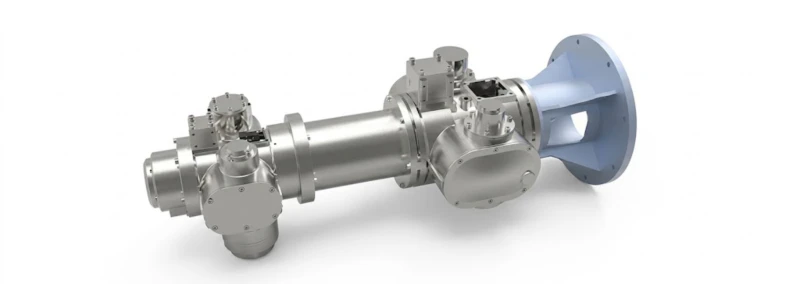
A single-screw compressor consists of a cylindrical main screw rotor — a helical grooved drum — that rotates inside a close-tolerance cylinder bore. Two flat, star-shaped gate rotors are positioned on either side of the main rotor at 90 degrees to its axis. As the main rotor turns, the helical grooves on its surface mesh with the teeth of the gate rotors, trapping volumes of gas in the groove cavities. As the rotor continues to turn, these trapped volumes are progressively reduced in size as the gate rotor teeth advance along the groove, compressing the gas until the discharge port is reached and the compressed gas is expelled to the discharge line.
The critical structural feature of the single-screw geometry is force balance. Because the two gate rotors are positioned symmetrically on opposite sides of the main rotor, the compression forces generated in one groove cavity are exactly opposed by the forces generated in the corresponding cavity on the other side. The net radial force on the main rotor bearing is therefore essentially zero during steady-state operation — a property unique to the single-screw architecture among all positive displacement compressor types. The axial forces on the main rotor are similarly balanced by the symmetrical groove arrangement.
In water-lubricated variants, pure water is injected into the compression chamber throughout the compression stroke, providing sealing between the rotor and cylinder surfaces, absorbing the heat of compression to maintain near-isothermal conditions, and supplying the fluid film that prevents metal contact between the rotating elements. No lubricating oil is involved at any point in the compression process.
How an Oil-Free Reciprocating Compressor Works
A reciprocating compressor achieves compression through the linear back-and-forth motion of a piston inside a cylinder bore. As the piston moves away from the cylinder head (the suction stroke), the cylinder volume increases, drawing gas in through the suction valve. As the piston moves toward the cylinder head (the compression stroke), the cylinder volume decreases, compressing the trapped gas until the discharge pressure is sufficient to force the discharge valve open and expel the gas to the discharge line. In oil-free reciprocating compressors, the piston rings are made from self-lubricating materials — typically PTFE-based composites — that provide the necessary sealing without requiring oil lubrication in the cylinder bore.
The reciprocating mechanism generates large, cyclically varying forces. The inertia of the piston, connecting rod, and crank mechanism creates unbalanced forces that vary sinusoidally with crank angle, imposing significant dynamic loads on the crankshaft bearings and foundation structure. These forces must be managed through careful balancing design (opposing cylinder arrangements, balance weights) but cannot be fully eliminated. The suction and discharge valves — spring-loaded reed or poppet valves that open and close automatically with each stroke — are subjected to hundreds of millions of operating cycles over the compressor’s service life, making them the most maintenance-intensive components in the machine.
Architectural Insight: The fundamental distinction between single-screw and reciprocating technology is motion type — rotary versus reciprocating. Rotary machines, once set in motion, convert kinetic energy to compression work continuously and smoothly. Reciprocating machines must repeatedly accelerate and decelerate a piston mass, converting kinetic energy to compression work intermittently and with large cyclical force variations. These different motion characteristics underlie nearly every performance difference between the two technologies.
Thermodynamic Efficiency: Isothermal vs Adiabatic Compression
The thermodynamic efficiency of a compressor is determined by how closely its actual compression process approaches the theoretical ideal. For the compression of air in an oxygen plant application, the relevant theoretical reference points are isothermal compression (compression at constant temperature — the thermodynamic optimum requiring the least work) and adiabatic compression (compression without heat exchange with the surroundings — the result of an instantaneous compression process). Real compression processes fall between these extremes, with the specific work input per unit mass of gas compressed being lower for processes closer to isothermal.
Why Water-Lubricated Single-Screw Compression Is Near-Isothermal
In a water-lubricated single-screw compressor, water is injected directly into the compression space throughout the compression stroke in quantities carefully calculated to absorb substantially all of the heat generated by compression before it can raise the temperature of the gas significantly. Water has a specific heat capacity approximately 3,500 times greater than an equal mass of air — meaning that a relatively small mass of water can absorb a large quantity of compression heat with only a minor rise in water temperature. The result is that the gas temperature during compression remains close to the inlet temperature throughout the stroke, producing a compression process that closely approximates isothermal compression.
In quantitative terms, the discharge temperature of a water-lubricated single-screw compressor compressing air from atmospheric pressure to 7 bar gauge is typically 40°C to 60°C above ambient — compared with 180°C to 220°C above ambient for an equivalent adiabatic reciprocating compressor without intercooling, and 80°C to 120°C for an intercooled two-stage reciprocating unit. This lower discharge temperature directly reduces the specific compression work, resulting in lower energy consumption per unit volume of compressed air produced.
Why Reciprocating Compression Is Fundamentally Adiabatic
In an oil-free reciprocating compressor, the compression stroke is fast relative to the rate of heat transfer from the compressed gas to the cylinder walls. Because the oil-free piston rings rely on PTFE self-lubricating materials rather than an oil film for sealing, the thermal contact between the gas and the cylinder wall is also reduced relative to oil-lubricated alternatives. The net result is that the compression process in an oil-free reciprocating compressor is substantially adiabatic — most of the heat of compression remains in the gas, significantly raising the discharge temperature and increasing the specific compression work compared with the near-isothermal process in a water-lubricated single-screw unit.
Multi-stage reciprocating compressors address this thermodynamic inefficiency by dividing the compression into two or three stages, with intercoolers between stages to remove compression heat between stages. This intercooling brings the overall compression process closer to isothermal, but at the cost of additional mechanical complexity (more stages, more valves, more cylinders), additional cooling water or air-side infrastructure for the intercoolers, higher capital cost, and increased maintenance requirements compared with a single-stage compressor.
Discharge temp above ambient — water-lubricated single-screw
Discharge temp above ambient — single-stage oil-free reciprocating
Typical energy saving vs fixed-speed reciprocating with VFD single-screw
Max stable discharge pressure — single-stage water-lubricated single-screw
Mechanical Reliability: The Air Valve Problem and Its Consequences
If thermodynamic efficiency is the first major differentiator between single-screw and reciprocating technology, mechanical reliability is the second — and for many oxygen plant operators, it is the more immediately felt operational concern. The mechanical reliability of a compressor directly determines plant availability, maintenance planning requirements, and the risk of unplanned production shutdowns that interrupt oxygen supply to downstream processes.
Suction and Discharge Valves: The Achilles’ Heel of Reciprocating Compressors
In a reciprocating compressor operating at 1,000 rpm with a double-acting cylinder, each suction and discharge valve opens and closes 1,000 times per minute — 60,000 times per hour, 480,000 times per 8-hour shift, and over 4 billion times per year of continuous operation. Each opening and closing cycle subjects the valve plate or reed to a stress event. The valve material — typically stainless steel, Inconel, or a thermoplastic composite — has a finite fatigue life measured in cycles, and valve failure from fatigue cracking is statistically inevitable over a long enough operating period.
In practice, valve maintenance is the dominant cost and downtime item for reciprocating compressors in continuous industrial duty. Valve inspection and replacement intervals of 4,000 to 8,000 operating hours are common for oil-free reciprocating compressors in PSA oxygen plant service, meaning that a continuously operating compressor may require valve servicing two to four times per year. Each valve servicing event requires compressor shutdown, disassembly of the cylinder head, inspection and replacement of valve assemblies, reassembly, and recommissioning — a maintenance operation that typically requires 4 to 8 hours of technician time per cylinder.
Valve failure between scheduled maintenance intervals — caused by valve cracking, foreign particle ingestion, or excessive differential pressure — results in unscheduled shutdowns that interrupt oxygen production. In oxygen-dependent industrial processes such as electric arc furnaces or medical gas systems, even a brief interruption to oxygen supply can have disproportionate operational consequences. The need to maintain comprehensive spare valve inventories adds further to the total maintenance cost of reciprocating compressor installations.
Single-Screw Compressors Have No Intake or Discharge Valves
The single-screw compressor geometry does not require intake or discharge valves. Gas enters the compression grooves through fixed inlet ports as the main rotor turns, is trapped and compressed as the groove volume decreases with continued rotation, and is expelled through fixed discharge ports when the groove connects with the discharge opening. The entire compression cycle is controlled by the geometry of the rotating rotor — there are no moving valves, no springs, no valve plates, and no valve seats subject to fatigue cycling.
The elimination of air valves removes the single most maintenance-intensive failure mode in reciprocating compressor operation. Single-screw compressors running in PSA oxygen plant service typically achieve bearing inspection intervals of 16,000 to 24,000 operating hours — two to six times longer than the valve replacement intervals of equivalent reciprocating units — with correspondingly lower maintenance man-hours, lower spare parts consumption, and dramatically higher between-maintenance operating availability.
Piston Ring Wear: The Secondary Reciprocating Maintenance Item
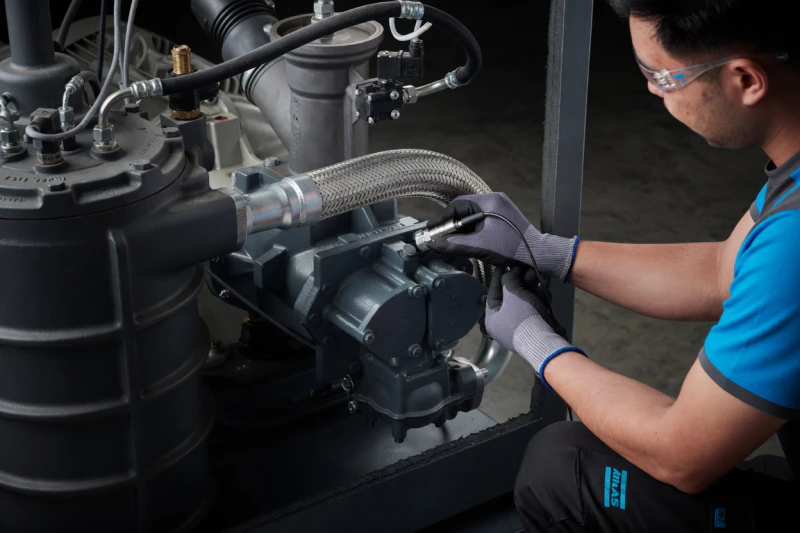
After air valves, piston rings are the second major wear item in oil-free reciprocating compressors. The self-lubricating PTFE-composite rings that seal the piston against the cylinder bore wear progressively with use — wear rates are higher in oil-free operation than in oil-lubricated compressors because there is no lubricating oil film to reduce ring-to-bore contact stress. As piston rings wear, blow-by (gas leakage past the rings from the compression space to the crankcase) increases, reducing volumetric efficiency and eventually requiring ring replacement. In continuous industrial operation, piston ring replacement intervals of 8,000 to 16,000 hours are typical for oil-free reciprocating compressors.
Single-screw compressors have no piston rings. The sealing function is provided by the water film injected into the compression space, and the gate rotor tips that contact the main rotor cylinder surface are precision-machined from high-durability materials with very long service lives under the operating conditions of water-lubricated compression. There is no progressive wear mechanism in the single-screw geometry that is analogous to piston ring degradation.
Bearing Loading and Long-Term Reliability: The Force Balance Advantage
Compressor bearings are the primary mechanical elements that determine long-term reliability and overhaul life. In any compressor design, the bearings must support all static and dynamic forces generated by the compression process and the rotating machinery. The magnitude and character of these forces — whether they are steady, cyclically varying, or impulsive — directly determine bearing fatigue life and the interval between bearing replacement overhauls.
Reciprocating Compressor Bearing Loads: High, Cyclical, and Impulsive
In a reciprocating compressor, the crankshaft bearings must withstand the gas pressure forces transmitted through the connecting rod on every compression stroke, combined with the inertia forces from the accelerating and decelerating piston and rod assembly. These forces are cyclical — reversing direction with every stroke — and include impulsive components when the discharge valve snaps open under peak cylinder pressure. The bearing loading in a reciprocating compressor is therefore substantially higher and more damaging per operating cycle than in a rotary machine developing equivalent shaft power.
At the piston rod crosshead bearing (in larger reciprocating units) and the crankpin bearings, the loading reversal with each stroke creates conditions that can cause lubricant film breakdown during the load reversal, resulting in brief periods of boundary lubrication and associated wear. Over hundreds of millions of cycles in continuous industrial operation, this wear accumulates and necessitates bearing replacement at intervals typically of 16,000 to 24,000 hours in a well-maintained reciprocating compressor.
Single-Screw Bearing Loads: Near-Zero Net Radial Force
As described in the technology overview, the symmetrical two-gate-rotor geometry of the single-screw compressor produces compression forces that are inherently balanced — the force acting on the main rotor from the compression in one set of grooves is opposed by an equal and opposite force from the corresponding grooves on the other side. The net radial force on the main rotor bearing during steady-state compression approaches zero. The bearing loading is therefore dominated by the weight of the rotor and the minor unbalanced forces from manufacturing tolerances, rather than by the large gas pressure forces that dominate reciprocating compressor bearing loads.
In practice, this means that single-screw compressor main bearings operate at a small fraction of the bearing load seen in equivalent reciprocating machines. Rolling element bearing life is a function of load raised to the power of 3 (for ball bearings) or 10/3 (for roller bearings) — a halving of bearing load extends calculated bearing life by a factor of 8 or more. The dramatically lower bearing loads in single-screw compressors translate into extended bearing replacement intervals — often 40,000 to 60,000 operating hours or more — compared with 16,000 to 24,000 hours for reciprocating alternatives.
Vibration and Noise: Operational Implications for Industrial Facilities
Compressor vibration and noise affect not only the working environment in the compressor room but also the structural integrity of the installation, the performance of sensitive downstream instruments, and in some applications — notably medical facilities and precision manufacturing environments — the acceptability of the compressor as a utility equipment item at all.
Reciprocating Compressors: Inherently High Vibration
The reciprocating motion of the piston and connecting rod creates primary and secondary out-of-balance forces that cannot be completely eliminated by counterweighting or cylinder arrangement. Even well-balanced multi-cylinder reciprocating compressors generate measurable vibration levels at multiples of the running speed frequency. This vibration transmits through the compressor base frame to the foundation structure, requiring substantial foundation engineering to prevent transmission to adjacent structures. The cyclic valve impacts — the mechanical shock of valve plates snapping open and closed on every stroke — contribute a broadband noise component that makes reciprocating compressors significantly louder than equivalent rotary machines.
Typical sound pressure levels for industrial oil-free reciprocating compressors in the 15 to 75 kW power range are 75 to 85 dB(A) at one metre — a range that requires hearing protection for personnel working nearby and that may necessitate acoustic enclosures in noise-sensitive environments. The vibration characteristics of reciprocating compressors also shorten the service life of connected pipework fittings, instrumentation, and control system components through fatigue loading.
Single-Screw Compressors: Smooth, Low-Vibration Operation
The continuous rotary motion of the single-screw compressor generates no primary or secondary reciprocating out-of-balance forces. The main rotor and gate rotors rotate at constant angular velocity with no cyclically varying acceleration forces. Compression is continuous rather than pulsed, and there are no valve impact shock loads. The net result is vibration levels substantially below those of equivalent reciprocating machines — typically 60 to 70 dB(A) at one metre for units in the equivalent power range, and significantly reduced structural vibration transmission to the installation.
For medical facilities, precision manufacturing environments, and any application where compressor room is adjacent to occupied or noise-sensitive spaces, the quiet operation of single-screw compressors can eliminate the need for acoustic enclosures or vibration isolation mounts that would otherwise be required for reciprocating installations — a direct capital cost saving that partially offsets any compressor purchase price premium.
Compressed Air Purity: A Non-Negotiable Advantage of Single-Screw Technology
For PSA oxygen generation applications, compressed air purity is not merely an engineering performance parameter — it is the prerequisite for all downstream performance. Contaminated compressed air means contaminated zeolite molecular sieves, which means degraded oxygen purity and shortened sieve life, which means unplanned plant shutdowns and sieve replacement costs that can exceed the original capital cost of the compressor. The purity advantage of single-screw water-lubricated technology over oil-free reciprocating alternatives is therefore not merely a specification improvement — it is a fundamental operational assurance.
Oil-Free Reciprocating Compressors: Not Completely Oil-Free
The term “oil-free reciprocating compressor” refers to the absence of lubricating oil within the cylinder bore — the compression space itself is not lubricated with oil. However, oil-free reciprocating compressors do use lubricating oil in their crankshaft and connecting rod bearings, in the crosshead guides (in larger units), and in the gearbox (if present). These components are sealed from the compression space by shaft seals and distance pieces, but no seal system is perfectly effective under all operating conditions over the full service life of the machine.
Seal degradation — which begins from the first operating hours and accelerates progressively as the seals wear — can result in trace oil vapour migration from the crankcase to the compression space, particularly during cold starts when thermal expansion differences can temporarily open seal clearances. Under ISO 8573-1, an oil-free reciprocating compressor may be certified to Class 1 (≤0.01 mg/m³ oil content) but achieving and maintaining Class 0 certification — the standard required for medical and pharmaceutical PSA oxygen applications — is technically problematic for reciprocating designs because of this inherent oil containment limitation.
Water-Lubricated Single-Screw: Categorically Class 0
In a water-lubricated single-screw compressor, there is no oil anywhere in the machine — not in the compression chamber, not in the bearing housings, not in any component that has a fluid pathway connecting to the compression space. The bearings are water-lubricated, the gate rotor pivots use water-compatible bearing materials, and the entire fluid circuit within the machine contains only water. This design eliminates even the theoretical possibility of oil contamination of the compressed air discharge — a categorical rather than probabilistic guarantee of Class 0 air purity that is simply not achievable with any reciprocating design that uses oil for crankshaft lubrication.
Purity Distinction: Oil-free reciprocating compressors achieve oil-free compression by not lubricating the cylinder — but they still contain oil elsewhere in the machine. Water-lubricated single-screw compressors contain no oil anywhere. This is the difference between “oil-free compression” and a genuinely oil-free machine — and for ISO 8573-1 Class 0 certification, only the latter provides an unconditional compliance guarantee.
Variable Frequency Drive Performance: Which Technology Benefits More?
PSA oxygen plants operate with a cyclically varying compressed air demand driven by the adsorption-regeneration switching sequence of the zeolite beds. This variable demand means that a fixed-speed compressor must either run continuously at full load (wasting energy when demand is below peak) or cycle on and off (causing mechanical stress from repeated starting). Variable frequency drives (VFDs) allow the compressor to modulate its output continuously in response to demand, maintaining system pressure within tight limits while avoiding both energy waste and start-stop mechanical stress. However, the benefit of VFD operation differs significantly between single-screw and reciprocating technologies.
Single-Screw Compressors and Permanent Magnet VFD: Ideal Combination
Single-screw compressors are rotary machines with a smooth, continuous torque characteristic — the motor shaft torque required to drive the compressor varies only gradually as rotor speed changes. This smooth torque profile is ideal for permanent magnet synchronous motor (PMSM) drives controlled by variable frequency inverters. The PMSM delivers high torque efficiency from near-zero speed to full speed, and the VFD can modulate the motor speed smoothly across a wide range (typically 30% to 100% of rated speed) without mechanical stress or efficiency penalties. The combination of PMSM and VFD with a single-screw compressor provides continuous capacity modulation, precise pressure control, and energy savings of 20% to 35% compared with fixed-speed operation across the variable demand profile of a PSA plant.
Reciprocating Compressors and VFD: Significant Limitations
Reciprocating compressors can be equipped with VFDs, but the speed range over which a reciprocating compressor can operate safely and efficiently is much more restricted than for single-screw rotary units. At low speeds, the valve dynamics of a reciprocating compressor — which depend on differential pressure across the valve and the momentum of the valve plate — become less reliable, with increased risk of valve flutter and incomplete closure. Lubrication of the crankshaft bearings in a reciprocating compressor depends on oil film pressure generated by shaft rotation speed; at very low speeds, this film pressure may be insufficient, accelerating bearing wear. In practice, reciprocating compressors are typically limited to a speed reduction of 30% to 50% maximum — a much narrower modulation range than the 70% range achievable with single-screw PMSM VFD units. The energy saving from VFD operation on a reciprocating compressor is therefore significantly less than for an equivalent single-screw installation.
Head-to-Head Comparison: Single-Screw vs Reciprocating for PSA Oxygen Duty
The following table consolidates the engineering comparison across all major performance parameters relevant to PSA oxygen plant compressor selection. It is intended as a practical reference for specification decisions.
| Parameter | Water-Lubricated Single-Screw | Oil-Free Reciprocating |
|---|---|---|
| Compression Process | Near-isothermal — water injection absorbs heat throughout compression stroke | Near-adiabatic — gas temperature rises significantly; intercooling required for multi-stage |
| Specific Energy Consumption | Lower — near-isothermal compression minimises work input | Higher — adiabatic compression losses; partially recovered by intercooling in multi-stage |
| Air Valve Maintenance | None — no air valves in single-screw design | Major maintenance item — replacement every 4,000–8,000 hours |
| Piston Ring Wear | None — no pistons or piston rings | Progressive wear item — replacement every 8,000–16,000 hours |
| Bearing Load and Life | Near-zero net radial force — bearing life 40,000–60,000+ hours | High cyclical and impulsive loads — bearing replacement every 16,000–24,000 hours |
| ISO 8573-1 Oil Class | Class 0 — no oil present anywhere in machine | Class 1 typical — Class 0 difficult to guarantee due to crankcase oil presence |
| Vibration Level | Low — continuous rotary motion, no reciprocating out-of-balance forces | High — inherent primary and secondary out-of-balance forces from piston motion |
| Noise Level (15–75 kW range) | 60–70 dB(A) at 1m — no acoustic enclosure required in most applications | 75–85 dB(A) at 1m — acoustic enclosure often required |
| VFD Speed Modulation Range | 30–100% of rated speed — wide modulation range, excellent part-load efficiency | 50–100% of rated speed — limited range; valve reliability and lubrication concerns at low speed |
| Max Single-Stage Pressure | Up to 40 bar gauge — single-stage water-lubricated single-screw | 7–10 bar gauge single-stage; multi-stage required for higher pressures |
| Annual Maintenance Cost (relative) | Low — no valves, no piston rings, no oil system; primarily water quality management | High — valves (frequent), piston rings (periodic), crosshead guides, crankshaft bearings |
When Is a Reciprocating Compressor Still the Right Choice?
A fair engineering comparison requires acknowledging that there are application contexts where reciprocating compressors remain the appropriate specification, despite the advantages of single-screw technology in most PSA oxygen generation scenarios. Understanding these contexts prevents the error of specifying single-screw technology in situations where it is not optimal.
Very Small Flow Rates Below Single-Screw Minimum Capacity
Water-lubricated single-screw compressors have a practical minimum capacity below which the technology is not economically justified or technically optimal. For very small PSA oxygen plants producing less than 5 to 10 Nm³/h of oxygen — corresponding to feed air requirements below approximately 20 to 40 Nm³/h — small oil-free reciprocating compressors may be the more cost-effective and physically compact solution. The valve maintenance burden at these very small scales is manageable within an acceptable total cost of ownership.
Very High Pressure Applications Above 40 Bar
For applications requiring compressed air or gas at pressures above 40 bar gauge — such as high-pressure cylinder filling at 150 to 200 bar — multi-stage reciprocating compressors remain the most widely used technology. While single-screw compressors can achieve up to 40 bar in a single stage, ultra-high-pressure applications beyond this range are better served by multi-stage reciprocating designs that can achieve pressures of 300 bar or more through successive stages of compression with intercooling.
Specialised Gas Applications with Specific Compatibility Requirements
For the compression of gases other than air — including acetylene, hydrogen, carbon dioxide, and certain corrosive process gases — reciprocating compressors with specific material and seal configurations are sometimes the most appropriate technology. The interaction between water (the sealing medium in single-screw compressors) and the specific gas being compressed must be evaluated carefully for non-air applications, and in some cases water lubrication is not compatible with the gas composition, making dry-running or oil-lubricated reciprocating designs the correct choice.
Total Lifecycle Cost: Quantifying the Single-Screw Advantage
The engineering advantages of single-screw technology over reciprocating alternatives translate into a total lifecycle cost (TCO) advantage that becomes clearer and larger as the appraisal period extends. Purchase price comparisons — which sometimes show reciprocating compressors at lower initial cost for equivalent rated flow — are systematically misleading because they capture only 10% of the true total cost of ownership.
Energy costs (60% of TCO) consistently favour single-screw technology. The near-isothermal compression advantage typically reduces specific energy consumption by 8% to 18% compared with well-maintained multi-stage reciprocating units, and by 20% to 35% when combined with permanent magnet VFD operation. For a 75 kW compressor running 8,000 hours per year at an electricity cost of €0.10/kWh, a 15% energy saving represents €90,000 over a 15-year plant life — significantly exceeding any purchase price differential between technologies.
Maintenance costs (30% of TCO) show the most dramatic technology difference. The elimination of valve replacement, piston ring changes, and oil system maintenance reduces annual maintenance labour and parts costs by 60% to 75% compared with equivalent reciprocating installations. Over a 15-year plant life, this maintenance saving is very substantial in absolute terms, and the reduction in unplanned shutdown risk provides a further economic benefit through improved plant availability.
Zeolite sieve protection value is the third major TCO element unique to oxygen plant compressor selection. As detailed in the air purity discussion, the categorical Class 0 guarantee of water-lubricated single-screw technology fully protects the zeolite sieve investment from hydrocarbon fouling. The value of this protection — measured as the avoided cost of premature sieve replacement plus the avoided cost of off-specification product during sieve degradation — can easily exceed the total purchase price of the compressor.
Plant engineers who engage with a specialist single screw air compressor supplier during the project definition phase — rather than defaulting to reciprocating alternatives based on historical precedent or initial price — consistently identify lifecycle cost savings that substantially justify the technology upgrade, often recovering the full cost differential within the first 24 to 36 months of operation.
Conclusion: Single-Screw Technology Is the Engineering Standard for Industrial Oxygen Compressor Duty
The engineering comparison presented in this article demonstrates that water-lubricated single-screw compressors offer a comprehensive and substantial performance advantage over oil-free reciprocating compressors for PSA and VPSA industrial oxygen generation duty across all major parameters: thermodynamic efficiency, mechanical reliability, compressed air purity, vibration and noise characteristics, variable frequency drive compatibility, and total lifecycle cost.
These advantages are not incremental refinements — they arise from the fundamental architectural differences between continuous rotary compression with inherent force balance and near-isothermal water injection, versus intermittent reciprocating compression with cyclically varying forces, high-wear air valves, and adiabatic thermodynamics. For medium to large PSA oxygen plant applications — from 20 Nm³/h feed air upward — single-screw water-lubricated technology represents the engineering standard against which reciprocating alternatives should be evaluated, not the reverse.
For industrial oxygen plant operators currently running reciprocating compressor installations and experiencing the characteristic maintenance burden of regular valve replacement, piston ring changes, and elevated energy consumption, the business case for migration to single-screw technology is compelling and should be evaluated on a total lifecycle cost basis. Early engagement with a specialist in industrial oxygen compressor applications provides the application-specific data needed to build a robust investment case for technology upgrade.
Ready to Upgrade from Reciprocating to Single-Screw for Your Oxygen Plant?
Our engineering team provides application-specific single-screw compressor selection, lifecycle cost modelling, and drop-in replacement guidance for PSA oxygen plants currently running reciprocating compressor installations. Class 0 certified water-lubricated units with permanent magnet VFD available from local stock for Russia and CIS markets.
Request a Technical Consultation
Browse Our Air Compressor Range